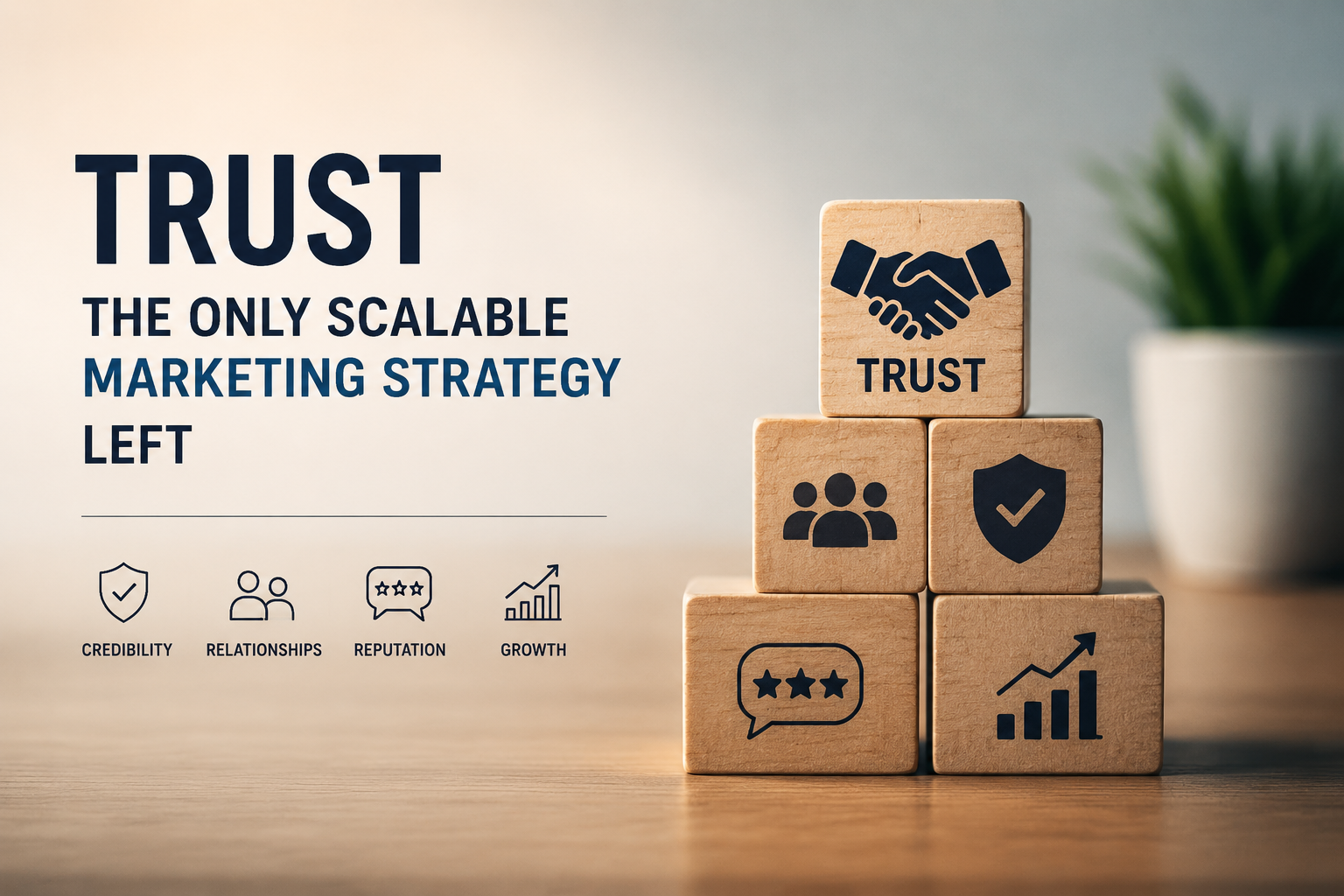
For years, marketing scaled through exposure.
More ads.
More impressions.
More reach.
More conversions.
The assumption was simple:
If enough people see you, some will buy.
And for a long time, that worked.
But something fundamental has changed.
Visibility is no longer the bottleneck.
Trust is.
Today, brands can reach millions of people.
But reaching people is not the same as convincing them.
Attention is accessible.
Clicks are accessible.
Traffic is accessible.
Trust is not.
And without trust, none of those inputs scale into meaningful growth.
The Decline of Blind Consumer Trust
There was a time when brands benefited from default credibility.
If a company existed, it was assumed to be legitimate.
If an ad was published, it was assumed to be somewhat truthful.
If a product was available, it was assumed to meet a basic standard.
That baseline has eroded.
Consumers today operate with higher skepticism.
They have seen:
- Misleading ads
- Overpromised products
- Fake reviews
- Low-quality experiences
- Short-lived brands
This has trained them to question before they trust.
Instead of assuming credibility, they now look for proof.
They ask:
Is this real?
Can I trust this?
Is this worth my attention?
Trust is no longer given.
It is evaluated.

Skepticism Toward Ads and Influencers
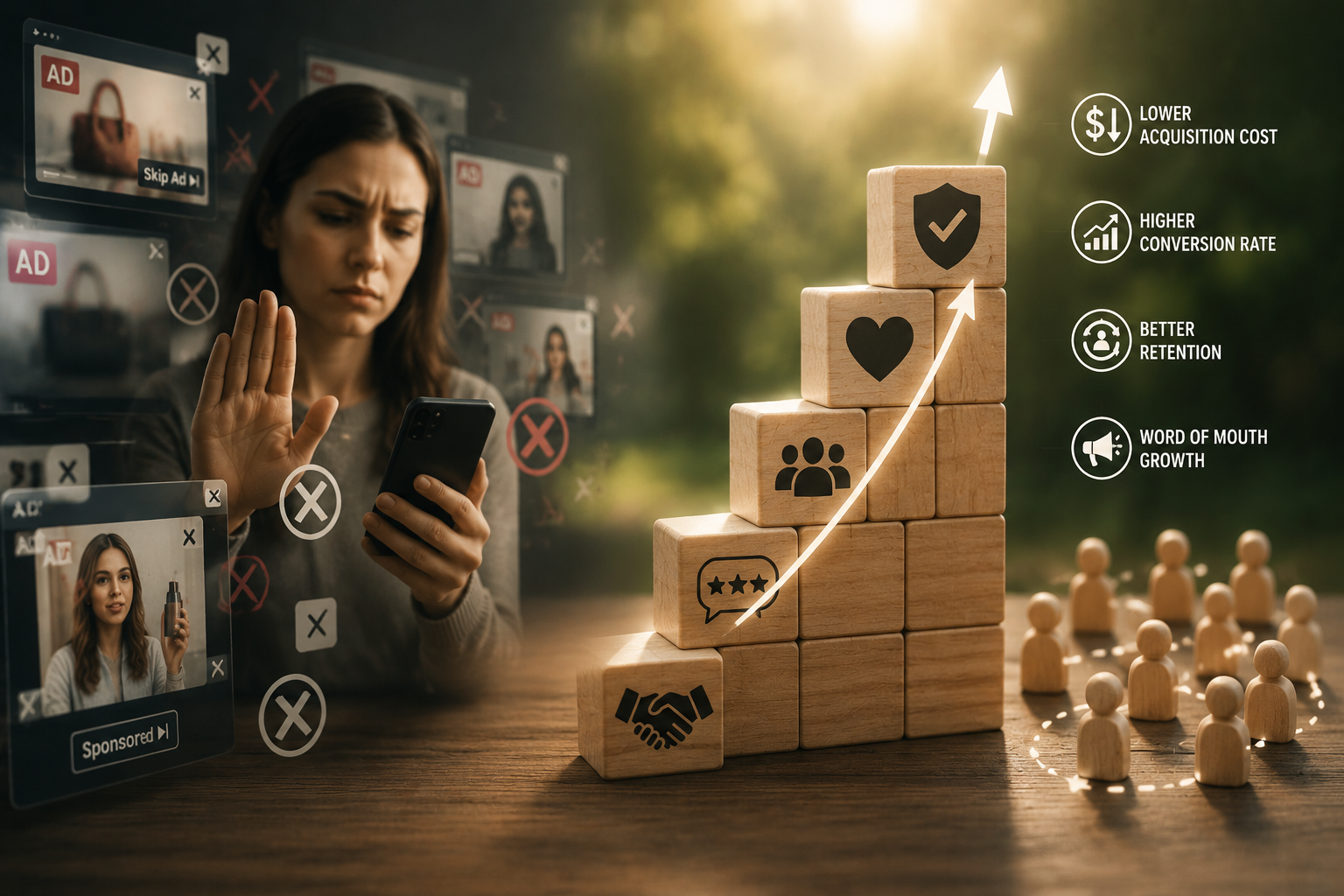
Traditional persuasion channels have weakened.
Ads are still visible.
But their persuasive power has decreased.
People recognize ad formats instantly.
They skip, scroll, or ignore them.
They assume bias.
Influencer marketing followed a similar trajectory.
It started with authenticity.
Real people sharing real experiences.
But as it scaled, it became commercialized.
Audiences became aware of sponsorships, scripts, and incentives.
Trust did not disappear.
But it became selective.
People trust specific creators, not the system itself.
This means borrowed trust is less reliable.
Brands can no longer depend entirely on:
Paid ads
Influencer endorsements
Short-term campaigns
Because these channels are filtered through skepticism.
Trust as a Compounding Asset
Unlike reach or traffic, trust compounds.
It builds slowly.
Through repeated positive interactions.
Through consistency.
Through delivering what is promised.
Each interaction either strengthens or weakens it.
When trust increases, something important happens:
Decision friction decreases.
Customers need less convincing.
They compare less.
They hesitate less.
This reduces acquisition cost.
It increases conversion rates.
It improves retention.
It encourages word of mouth.
Trust creates leverage.
Because it reduces the effort required to sell.
And over time, this effect compounds.
A brand with trust does not need to restart from zero with every campaign.
It builds on what already exists.
Content as Proof, Not Persuasion
In the current environment, content plays a different role.
It is no longer just a tool for persuasion.
It is a tool for proof.
Audiences do not want to be told.
They want to see.
They want to understand:
How the product works
How the brand thinks
How the company behaves
How customers experience it
Content that builds trust does not only say “we are good.”
It shows:
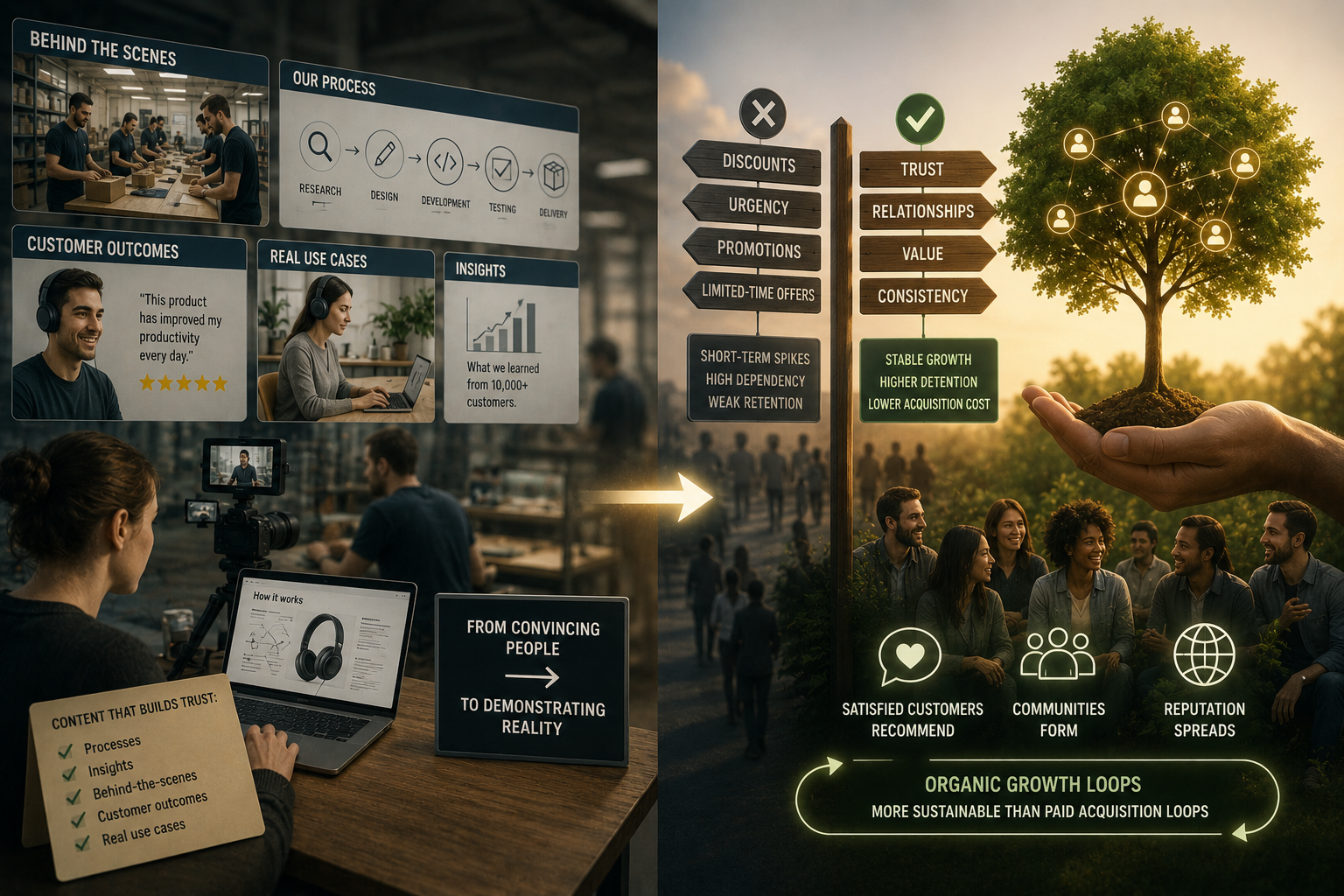
Processes
Insights
Behind-the-scenes
Customer outcomes
Real use cases
This shifts the purpose of marketing.
From convincing people
to demonstrating reality.
Proof is more powerful than claims.
Because proof reduces uncertainty.
And trust grows when uncertainty decreases.
How Trust Scales Better Than Sales Tactics
Many growth strategies focus on short-term conversion.
Discounts.
Urgency.
Promotions.
Limited-time offers.
These tactics can generate spikes.
But they do not build long-term strength.
They often create dependency.
Customers return only when incentives are present.
Trust-based growth works differently.
It reduces the need for constant incentives.
Customers come back because they believe in the brand.
Not because they are pushed.
This makes growth more stable.
More predictable.
More efficient.
Trust also scales through networks.
Satisfied customers recommend.
Communities form.
Reputation spreads.
This creates organic growth loops.
Which are more sustainable than paid acquisition loops.
The Climax: Without Trust, Growth Stalls
This is the core reality.
Without trust, growth becomes expensive.
Every conversion requires effort.
Every sale requires persuasion.
Every campaign starts from zero.
This leads to:
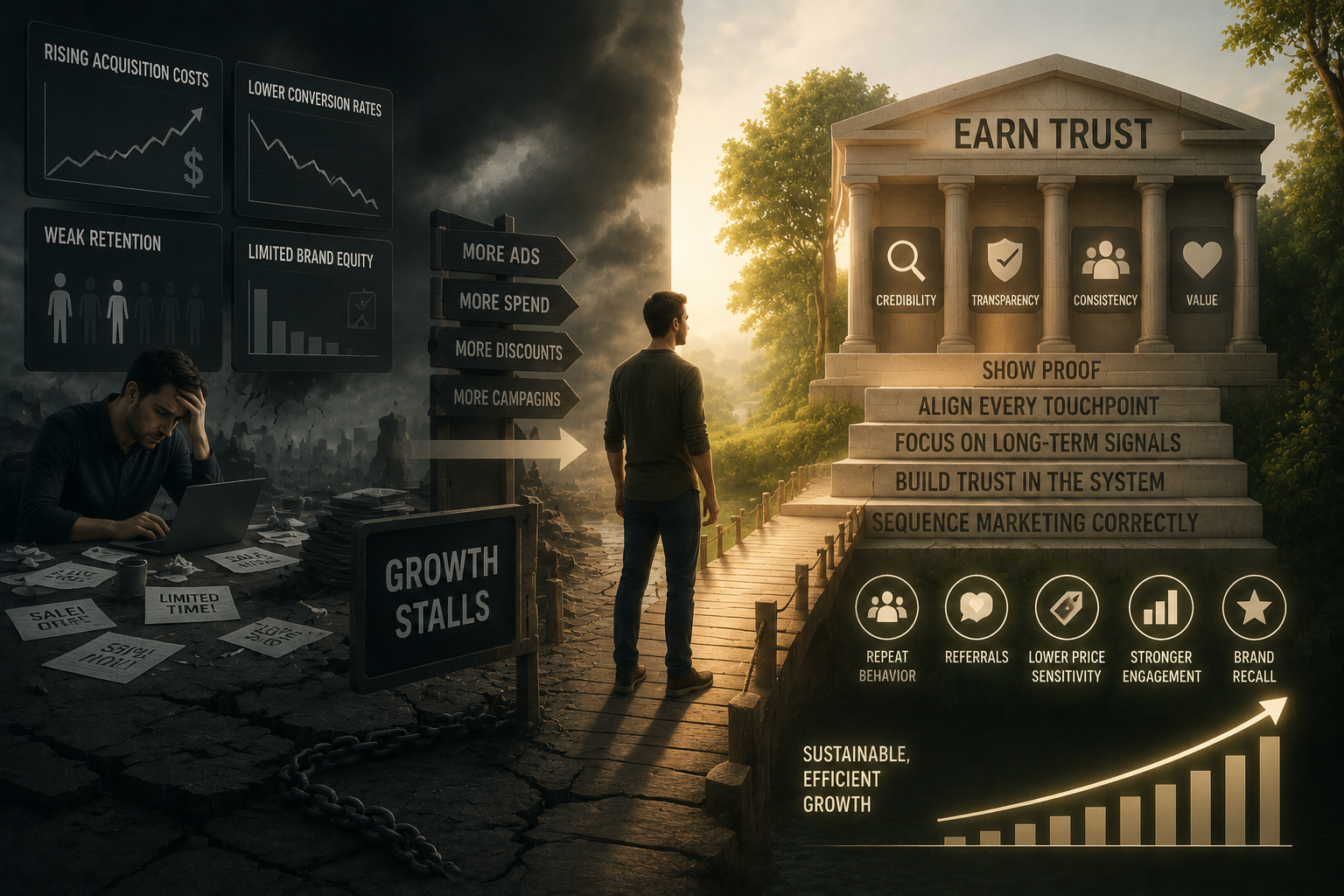
Rising acquisition costs
Lower conversion rates
Weak retention
Limited brand equity
A business can still grow.
But it becomes harder over time.
More budget is required to achieve the same results.
Eventually, growth slows.
Not because demand disappeared.
But because trust never accumulated.
Trust is what allows growth to scale efficiently.
Without it, scale becomes fragile.
CTA: Earn Trust Before Asking for Action
If trust is now the primary constraint in marketing, then the sequence most businesses follow is backward.
They ask for action first.
Click.
Buy.
Sign up.
Convert.
And only after that do they try to build credibility.
This worked in environments where attention was easier and skepticism was lower.
It does not work anymore.
Because today, the customer’s first reaction is not curiosity.
It is evaluation.
So the real question is not:
How do we get more conversions?
It is:
Have we earned the right to ask for them?
Step 1: Shift from Persuasion to Credibility
Most marketing is still designed to persuade.
Stronger claims.
Better hooks.
More urgency.
But in a skeptical market, persuasion without credibility creates resistance.
People do not trust what sounds convincing.
They trust what feels verifiable.
This requires a shift:
From saying → to showing
From promising → to demonstrating
From pushing → to proving
Trust grows when the brand reduces uncertainty.
And uncertainty is reduced through transparency, not intensity.
Step 2: Build Proof Into the System, Not Just Campaigns
Trust cannot be built through occasional efforts.
It must be embedded into how the brand communicates consistently.
That means:
- Showing real use cases regularly
- Sharing behind-the-scenes processes
- Explaining decisions and trade-offs
- Highlighting real customer outcomes
- Addressing weaknesses honestly when needed
These are not one-time tactics.
They are ongoing signals.
Over time, these signals accumulate into perception.
And perception becomes trust.
Step 3: Align Every Touchpoint
Trust is fragile when experiences are inconsistent.
If your ad is clear but your website is confusing, friction appears.
If your content feels authentic but your sales process feels aggressive, credibility drops.
If your brand voice shifts constantly, reliability weakens.
Trust is not built in one place.
It is built across all touchpoints.
Every interaction either reinforces or contradicts what you claim.
Consistency across these interactions is what makes trust scalable.
Step 4: Optimize for Long-Term Signals, Not Short-Term Metrics
Many brands optimize for:
Clicks
CTR
Conversions
Cost per acquisition
These metrics matter.
But they do not capture trust directly.
Trust appears in slower, more meaningful signals:
- Repeat behavior
- Organic referrals
- Lower price sensitivity
- Higher engagement depth
- Stronger brand recall
If these signals are weak, growth will become more expensive over time.
Because you are relying on tactics, not trust.
Step 5: Sequence Marketing Correctly
The most important shift is sequencing.
Old approach:
Exposure → Persuasion → Conversion
New reality:
Exposure → Credibility → Trust → Conversion
If credibility is missing, persuasion fails.
If trust is missing, conversion is unstable.
If conversion happens without trust, retention suffers.
This is why many businesses can acquire customers but struggle to keep them.
They optimize for the end of the funnel without strengthening the foundation.
Final Perspective
Trust is not built quickly.
But it is lost quickly.
And in modern markets, rebuilding trust is far more expensive than building it correctly from the start.
This is why trust is the only truly scalable marketing asset.
Because once it exists:
You need fewer incentives.
You need less persuasion.
You need less budget per conversion.
Growth becomes more efficient.
And efficiency compounds.
So before asking for clicks, before increasing spend, before launching the next campaign, ask:
Have we created enough evidence for someone to trust us without pressure?
If the answer is no, the strategy is incomplete.
Because in today’s environment:
People do not act because they are convinced.
They act because they feel confident.
And confidence is built through trust, not tactics.