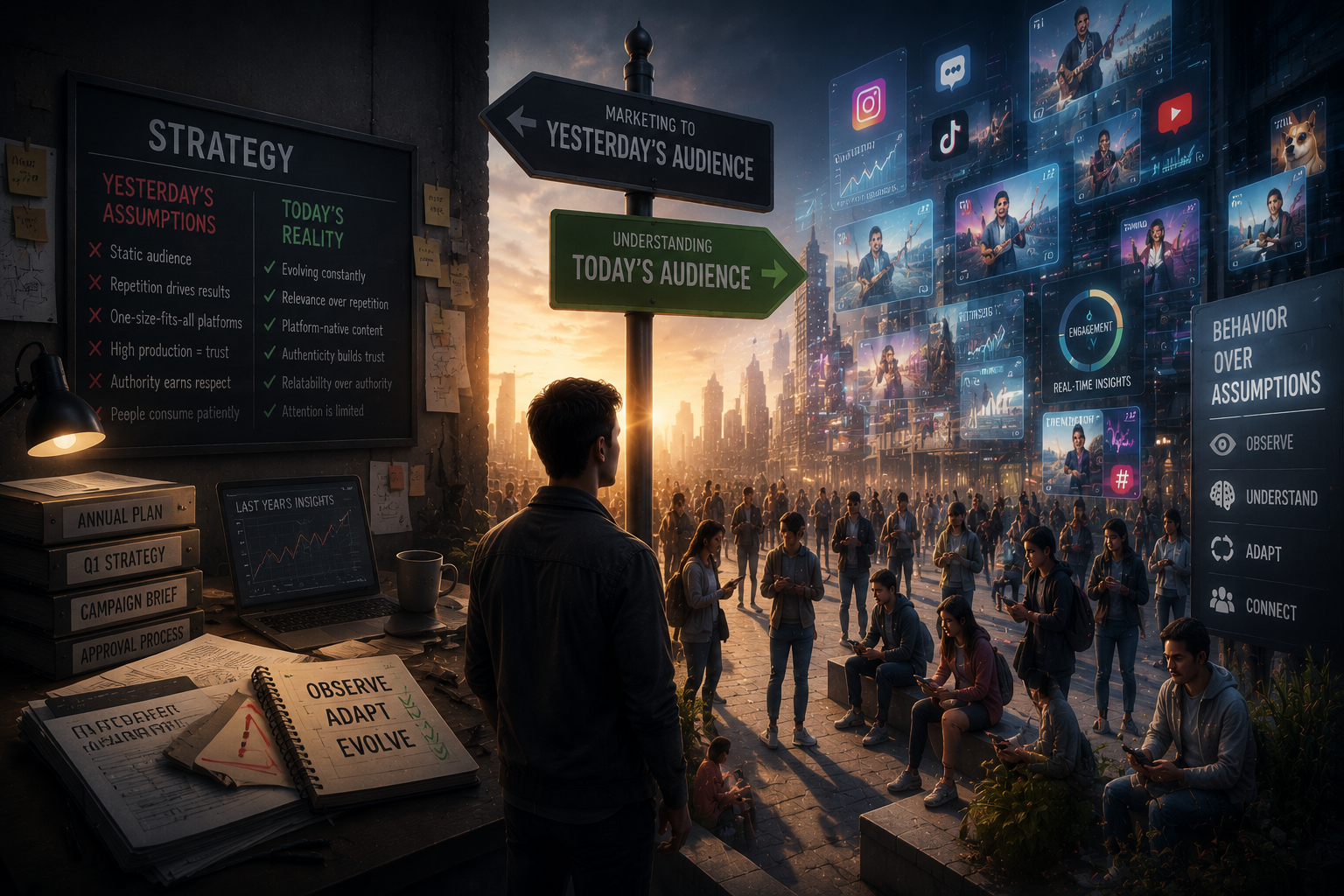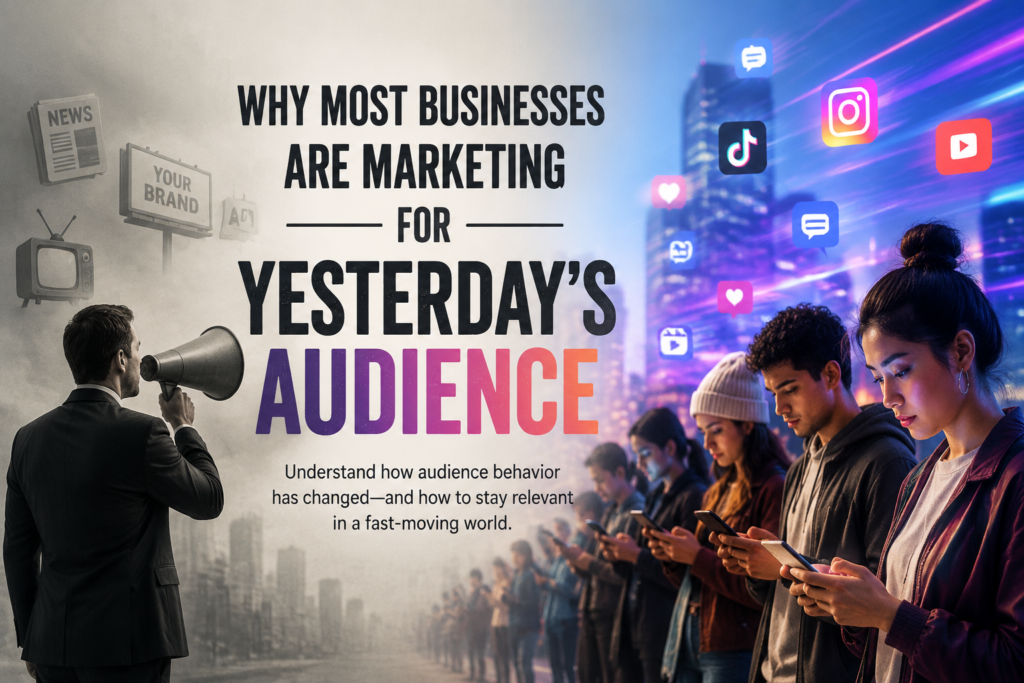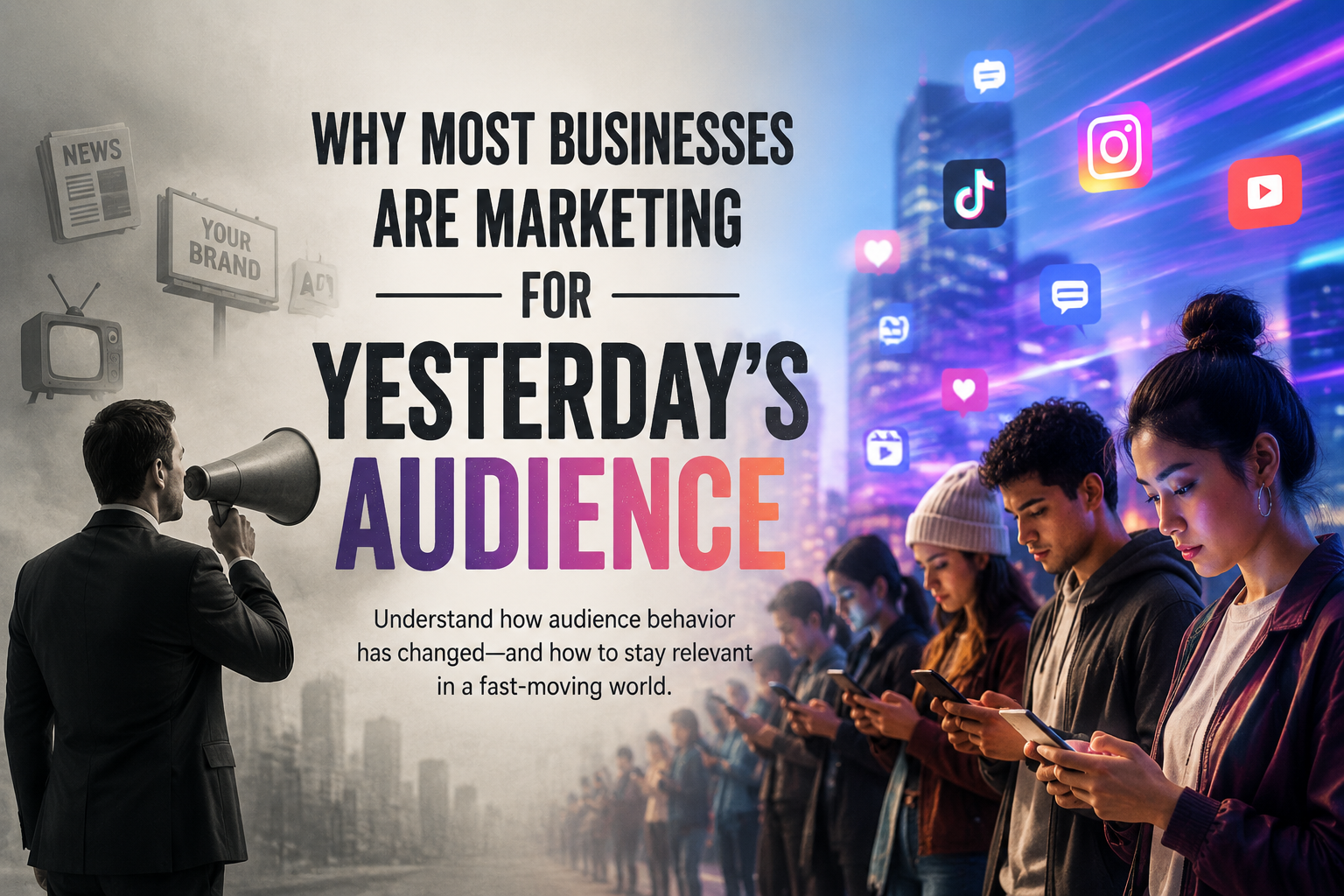
One of the biggest problems in modern marketing is not poor execution.
It is outdated understanding.
Many businesses believe they are speaking to today’s audience.
But in reality, they are still marketing to an older version of that audience.
An audience with different habits.
Different expectations.
Different attention patterns.
Different cultural behaviors.
This creates a dangerous lag.
The market evolves quickly.
Audience behavior changes quickly.
Platforms evolve quickly.
But brand strategy often moves slowly.
And when strategy lags behind behavior, relevance starts to decline.
The Lag Between Audience Behavior and Strategy
Most marketing systems are built for stability.
Campaign planning.
Approval processes.
Quarterly strategies.
Long production timelines.
But audience behavior does not evolve quarterly anymore.
It evolves continuously.
Platforms reshape consumption habits rapidly.
Cultural references change faster.
Attention patterns shift constantly.
This creates a structural mismatch.
By the time many brands adapt to a trend, behavior has already moved forward.
The result is familiar:
Brands using formats people are already tired of.
Brands communicating in tones that feel outdated.
Brands optimizing for behaviors audiences no longer have.
The audience changes first.
Strategy reacts later.
And that delay creates irrelevance.
New Consumption Habits Changed Everything
People no longer consume content the way they did even a few years ago.
Attention became fragmented.
Consumption became faster.
Expectations became higher.
Audiences now move through content in layers:
Scrolling
Scanning
Sampling
Skipping
This changes how communication works.
Long explanations lost power in many environments.
Polished corporate language feels less natural.
Over-produced content often feels less trustworthy.
At the same time, audiences increasingly prefer:
Speed
Authenticity
Clarity
Entertainment
Perspective
This does not mean depth disappeared.
It means depth must now compete for attention differently.
Modern audiences decide quickly whether something deserves continued attention.
And if the content fails that first test, the interaction ends immediately.

Platform-Native Content vs Recycled Content
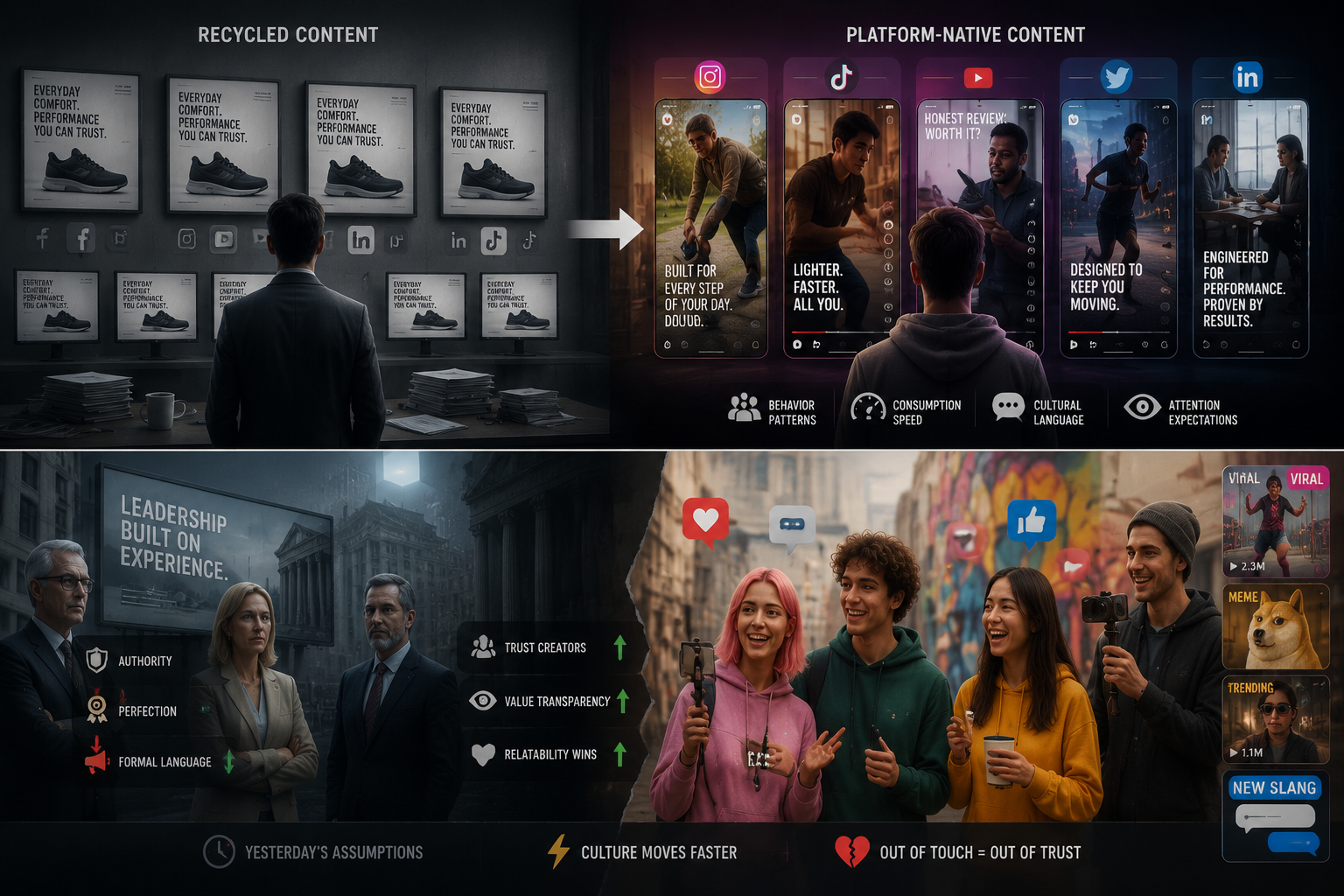
One of the clearest signs that a brand misunderstands today’s audience is recycled communication.
Taking the same message and forcing it across every platform rarely works anymore.
Because platforms are not identical distribution channels.
Each platform has its own:
Behavior patterns
Consumption speed
Cultural language
Attention expectations
Content that works on one platform may fail completely on another.
Why?
Because audiences behave differently in each environment.
Platform-native content understands this.
It adapts to context.
Recycled content ignores context.
And modern audiences recognize the difference instantly.
This is why some brands feel natural online while others feel intrusive or outdated.
Not because one has better products.
But because one understands audience behavior more accurately.
Age, Culture, and Attention Shifts
Audience behavior is not only changing technologically.
It is changing culturally.
Different generations consume information differently.
Different age groups interpret branding differently.
Even humor, trust, authority, and credibility signals have shifted.
For example:
Younger audiences often trust creators more than institutions.
They value transparency more than polished perfection.
They respond faster to relatability than formal authority.
At the same time, cultural cycles move faster than before.
Trends emerge quickly.
Language evolves quickly.
Online norms shift continuously.
Brands operating with outdated cultural assumptions become disconnected.
Not because they are invisible.
But because they feel out of touch.
And in modern marketing, being out of touch reduces trust.
Brands Are Still Operating on Old Assumptions
Many businesses still assume:
- Attention can be forced through repetition
- Professionalism automatically creates trust
- High production equals high performance
- Audiences consume content patiently
- Brand authority is automatically respected
These assumptions were more accurate in older media environments.
They are less reliable now.
Today, audiences evaluate quickly.
They ignore aggressively.
Question constantly.
Filter instinctively.
Trust must be earned repeatedly.
Attention must be justified immediately.
And relevance must be maintained continuously.
This creates pressure on brands that still operate with older communication logic.
Because audiences evolve faster than corporate systems do.
The Climax: Relevance Expires Fast
This is the central reality modern brands face:
Relevance is no longer stable.
It expires quickly.
A strategy that worked two years ago may already feel outdated today.
A content style that once felt modern can suddenly feel forced.
An audience behavior pattern can shift faster than many brands can adapt.
This is why relevance became one of the most fragile assets in marketing.
Brands do not disappear only because competitors outperform them.
Sometimes they disappear because audiences emotionally move on.
The brand still exists.
But the audience no longer feels connected to it.
And once relevance fades, recovery becomes expensive.
Because the brand must fight not only for attention.
But for renewed cultural alignment.

CTA: Study Today’s Audience, Not Last Year’s
If audience behavior changes continuously, then marketing cannot rely on static assumptions.
Brands must stop asking:
What worked before?
And start asking:
How are people behaving right now?
Step 1: Observe Behavior, Not Just Metrics
Analytics matter.
But behavioral observation matters too.
Watch:
- How people consume content
- What formats hold attention
- What language feels natural
- What audiences ignore immediately
Because behavior often changes before metrics reveal it clearly.
Step 2: Build for Platforms, Not Around Them
Do not treat platforms as identical distribution tools.
Each platform has its own culture.
Content should adapt to:
Speed
Tone
Format
Audience expectations
This does not mean losing brand identity.
It means expressing identity in platform-native ways.
Step 3: Reduce Strategic Delay
Many brands react too slowly.
By the time approval systems finish adapting, audience behavior already shifted again.
This requires more flexible marketing structures.
Faster learning.
Faster testing.
Faster adaptation.
Modern relevance requires responsiveness.
Step 4: Continuously Re-Evaluate Assumptions
The most dangerous phrase in marketing is:
“Our audience doesn’t behave like that.”
Because often, they already do.
Brands simply have not noticed yet.
Assumptions must be challenged continuously.
Especially successful assumptions.
Because success from the past can create blindness to present changes.
Final Perspective
The audience is no longer static.
It evolves continuously.
Not every few years.
Sometimes every few months.
Sometimes even faster than that.
Attention patterns shift.
Platform behaviors shift.
Cultural language shifts.
Trust signals shift.
And the brands that fail to notice these shifts slowly become disconnected from the people they are trying to reach.
This is why modern marketing is no longer just communication.
It is observation.
The brands that succeed are often the ones that detect behavioral changes early and adapt before competitors do. They pay attention not only to metrics, but to how audiences actually behave, consume, react, and interpret content in real time.
Because strategy built on outdated assumptions eventually creates outdated marketing.
Even strong products struggle when communication feels disconnected from current audience reality.
This is one of the biggest hidden risks in modern branding:
A company can still be operationally strong while becoming culturally irrelevant.
And cultural irrelevance compounds quietly.
At first, engagement weakens.
Then trust weakens.
Then attention decreases.
Then growth slows.
By the time the problem becomes obvious, the audience has often already moved elsewhere.
This is why relevance today requires continuous adaptation.
Not changing identity constantly.
But updating communication, formats, and understanding continuously enough to remain aligned with how people actually think and behave now.
The brands that win are rarely the ones with the most stable tactics.
They are the ones with the most accurate understanding of current audience behavior.
So before optimizing campaigns, scaling ad spend, or producing more content, ask a more important strategic question:
Are we speaking to the audience as it exists today, or to the version of the audience we understood two years ago?
Because in modern markets, relevance has a short lifespan.
And brands that fail to evolve their understanding eventually start marketing to an audience that no longer exists.