For a long time, marketing celebrated talent.
Great designers.
Great copywriters.
Great campaign ideas.
Great videos.
Great creative direction.
The belief was simple:
The most talented brand wins.
The best idea wins.
The most creative campaign wins.
The most beautiful content wins.
But the marketing environment has changed.
And in the new environment, talent alone is no longer the main advantage.
Consistency is.
Not because talent stopped mattering, but because the system now rewards reliability more than occasional brilliance.
Many talented brands are invisible.
Many average brands are everywhere.
The difference is rarely talent.
It is consistency.
Talent vs Repetition
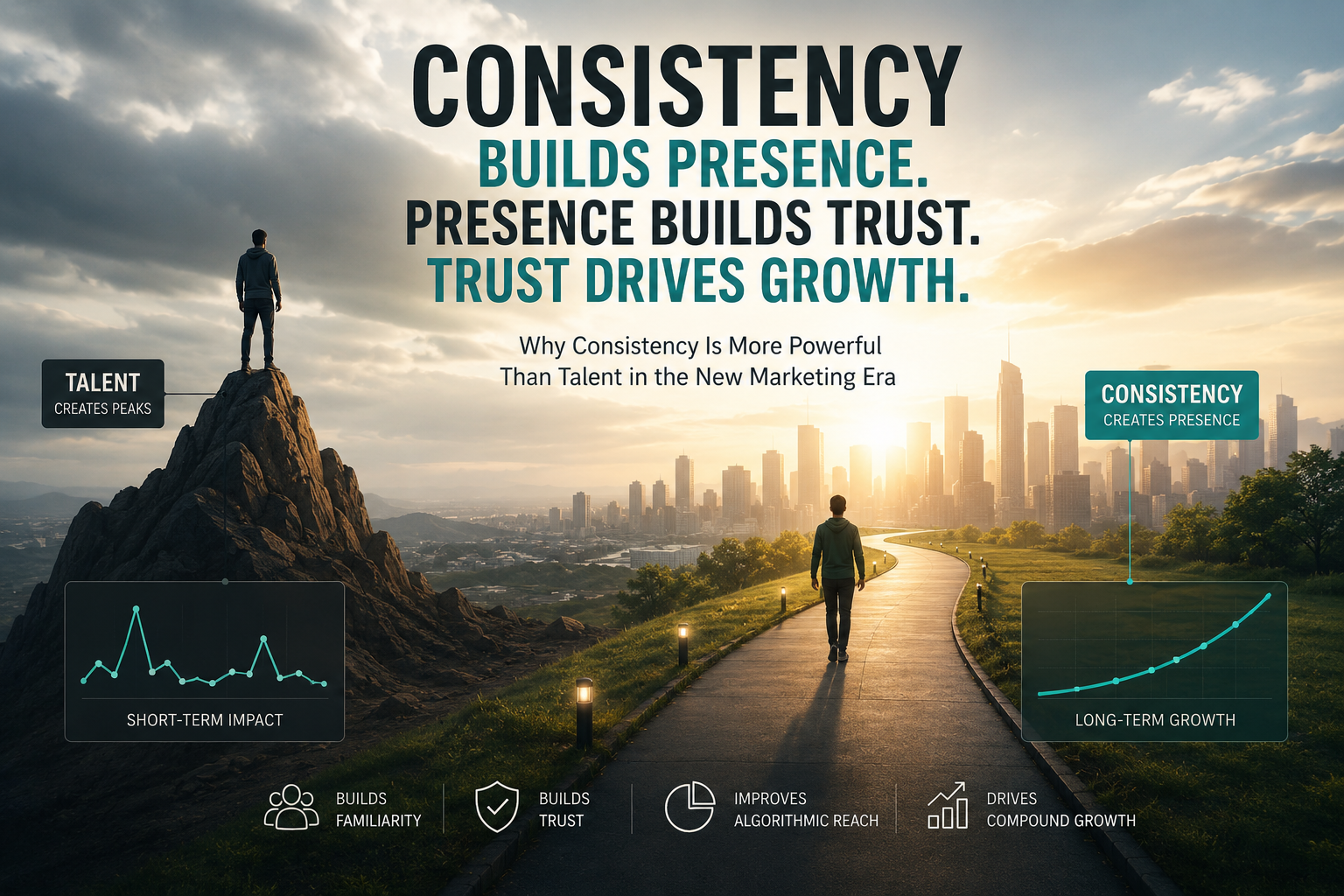
Talent creates peaks.
Consistency creates presence.
A talented brand might produce one amazing campaign, one great video, one brilliant post, and then disappear for weeks. When they return, they try to create another big moment.
This approach worked better in the old campaign-based marketing world, where brands communicated in waves. Campaigns had launch dates, media bursts, and clear time windows. Marketing was episodic.
Today, marketing is continuous.
Brands do not communicate in campaigns only. They exist in feeds, timelines, inboxes, and recommendation systems that update every minute.
This means brands are no longer competing only on idea quality.
They are competing on presence over time.
One brilliant post cannot compete with a brand that shows up every day for a year.
Not because the content is better.
But because repetition builds familiarity.
And familiarity builds trust.
And trust influences decisions.
In the new marketing environment, consistency often beats occasional excellence.

Algorithms Reward Reliability
One of the biggest reasons consistency matters more today is algorithmic distribution.
Platforms want active users and active creators. They prefer accounts that publish regularly, generate continuous engagement, and keep audiences on the platform.
This means algorithms often reward reliability.
Accounts that post consistently are tested more often. Their content appears more frequently in feeds, recommendations, and suggested content areas. The platform learns their audience faster and distributes their content more efficiently.
Accounts that post irregularly often lose this advantage.
When a brand disappears for weeks and then returns, the platform has less recent data about audience interaction. Distribution becomes weaker, and the content must perform extremely well to regain momentum.
In simple terms:
Consistency trains the algorithm.
Inconsistency resets the algorithm.
This does not mean posting constantly without strategy.
It means showing up predictably enough that the system recognizes you as an active participant, not an occasional visitor.
In algorithm-driven environments, reliability is a performance signal.
And performance signals influence reach.
Audience Trust Compounds Over Time
Consistency is not only about algorithms.
It is also about psychology.
People trust what they see repeatedly.
Not once.
Not twice.
Repeatedly over time.
When a brand appears regularly, shares useful or interesting content, and maintains a consistent voice and identity, audiences begin to recognize it. Recognition becomes familiarity. Familiarity reduces uncertainty. Reduced uncertainty increases trust.
Trust rarely comes from one viral post.
Trust comes from repeated exposure without disappointment.
If every time someone encounters your content it is useful, interesting, or relevant, they begin to expect value from you. That expectation is extremely powerful.
Consistency turns content into reputation.
Over time, the audience does not just see individual posts. They see a pattern. And people trust patterns more than isolated events.
This is why consistency compounds.
Each piece of content does not work alone. It builds on everything that came before it.
Inconsistent brands never benefit from this compounding effect.
They restart every time they return.

Why “On and Off” Kills Momentum
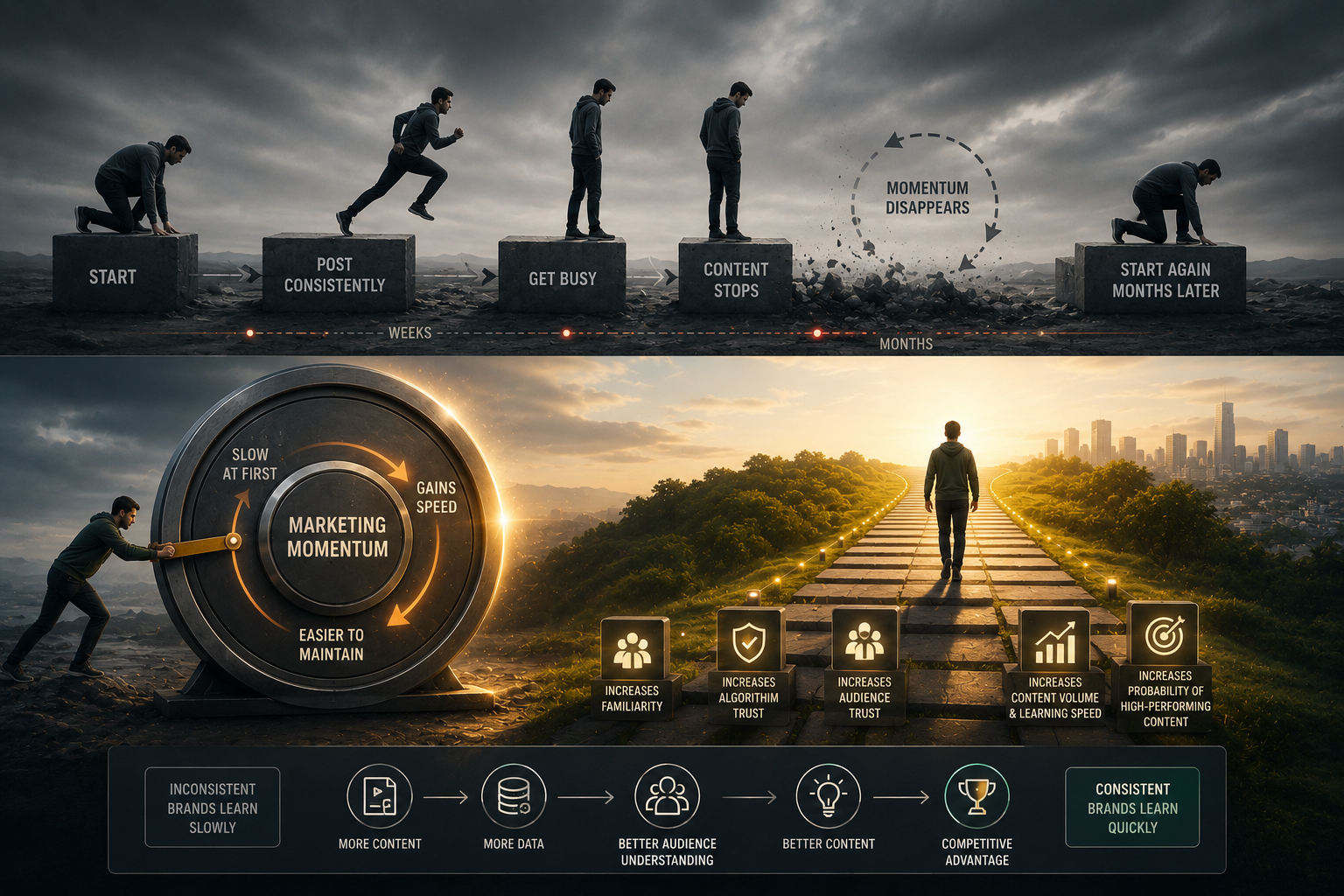
One of the most common patterns in marketing teams and businesses is the “on and off” cycle.
They start producing content.
They post regularly for a few weeks.
Then work gets busy.
Content stops.
Momentum disappears.
Then they start again months later.
This cycle is extremely damaging.
Because marketing momentum behaves like a flywheel.
It is slow at the beginning.
Then it gains speed.
Then it becomes easier to maintain.
But if you stop pushing, the wheel slows down and eventually stops.
Then when you restart, you are back at the beginning again.
Many brands think their content strategy is not working.
In reality, their consistency strategy is not working.
They never stay consistent long enough for results to compound.
They expect results from bursts.
But modern marketing rewards continuity, not bursts.
Bursts create spikes.
Consistency creates growth.
Consistency as a Strategic Advantage
Consistency is often misunderstood as discipline or work ethic.
But in marketing, consistency is actually a strategic advantage.
Because most competitors are inconsistent.
Most brands start content and stop.
Most brands post irregularly.
Most brands abandon platforms too early.
Most brands change direction constantly.
This means that simply showing up consistently already puts a brand ahead of many competitors.
Consistency does several strategic things at once:
It increases familiarity.
It increases algorithmic trust.
It increases audience trust.
It increases content volume and learning speed.
It increases the probability of high-performing content.
Consistency is also a learning mechanism.
The more content you produce, the more data you generate.
The more data you generate, the better you understand your audience.
The better you understand your audience, the better your content becomes.
Inconsistent brands learn slowly.
Consistent brands learn quickly.
Over time, this learning gap becomes a competitive gap.
The Climax: Invisible Brands Aren’t Untalented, Just Inconsistent
Many brands believe they are not growing because they are not creative enough, not talented enough, or not producing high-quality content.
Often, that is not the real problem.
The real problem is that they are invisible most of the time.
You cannot build brand awareness if you are absent.
You cannot build trust if you appear randomly.
You cannot build momentum if you stop repeatedly.
Invisibility is rarely caused by lack of talent.
It is usually caused by lack of consistency.
A moderately talented brand that shows up every week for three years will usually outperform a highly talented brand that appears only when they have time or inspiration.
Because in modern marketing, presence is power.
If people do not see you, they cannot remember you.
If they do not remember you, they cannot trust you.
If they do not trust you, they will not buy from you.
Consistency creates visibility.
Visibility creates familiarity.
Familiarity creates trust.
Trust creates business.
This chain is more powerful than occasional brilliance.
CTA: Build a System, Not Bursts
If consistency is so important, then the solution is not motivation.
It is systems.
Motivation is temporary.
Systems are repeatable.
Businesses should not rely on inspiration to create content.
They should build a system that makes consistency easier.
This can include:
Content calendars
Content formats that can be repeated
Batch production
Clear brand voice guidelines
Defined content pillars
Realistic posting schedules
Simple production workflows
The goal is not to create perfect content every time.
The goal is to stay present over time.
Because in the new marketing era, success often does not belong to the most talented brand.
It belongs to the brand that shows up, learns, improves, and stays visible long enough for trust and attention to compound.
Talent creates moments.
Consistency builds brands.
And brands are not built in bursts.
They are built in repetition.