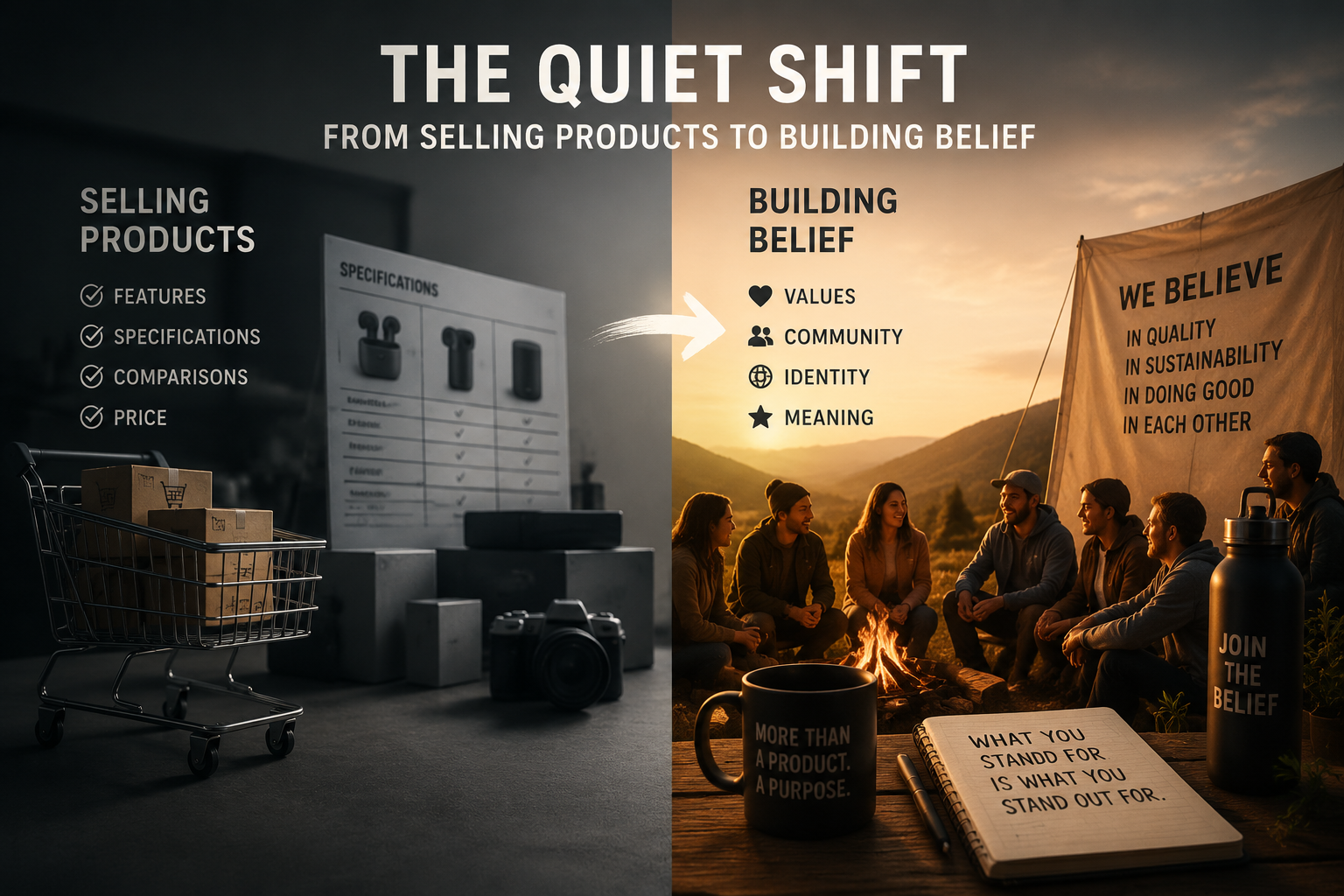
For decades, businesses focused on selling products.
Better features.
Better pricing.
Better performance.
Better comparisons.
The assumption was clear:
If the product is better, people will buy.
And for a long time, that logic worked.
But something has quietly changed.
Today, many of the fastest-growing brands are not just selling products.
They are selling beliefs.
Not explicitly.
Not always intentionally.
But structurally.
Because in a saturated market, products are easy to copy.
Belief is not.
Why People Buy Beliefs, Not Features
Most products today are functionally similar.
Competitors can match features.
They can match pricing.
They can match quality.
This makes differentiation harder.
When differences are small, decisions shift.
People stop choosing based only on what a product does.
They start choosing based on what a brand represents.
Beliefs simplify decisions.
Instead of asking:
Which product is technically better?
People ask:
Which brand feels right for me?
Which brand aligns with how I see the world?
Which brand reflects something about me?
Features justify decisions.
Beliefs drive them.

Emotional Alignment Over Rational Arguments
Marketing used to rely heavily on rational persuasion.
Specifications.
Benefits.
Comparisons.
Proof points.
These still matter.
But they are no longer sufficient.
Because decisions are rarely purely rational.
People do not just evaluate products.
They evaluate meaning.
Does this brand understand me?
Does it reflect my values?
Does it fit my identity?
This creates emotional alignment.
When alignment exists, decisions become easier.
People do not need long explanations.
They feel confident faster.
When alignment does not exist, even strong arguments struggle.
You can list features.
You can show data.
But if the brand does not feel relevant, the message does not land.
Emotion is not the opposite of logic.
It is the filter through which logic is accepted or rejected.
Community-Driven Brands vs Transactional Brands
This shift is visible in how brands relate to their audiences.
Transactional brands focus on exchange.
You give money.
You receive a product.
The relationship is short-term.
It resets after each purchase.
Community-driven brands operate differently.
They create shared meaning.
They attract people who believe similar things.
They build identity around participation.
They encourage belonging.
The product becomes part of a larger system.
A signal.
A symbol.
A shared reference point.
This changes behavior.
Customers become repeat buyers.
Buyers become advocates.
Advocates become part of the brand story.
Community increases retention, lowers acquisition costs, and strengthens brand resilience.
Not because the product changed.
But because the relationship changed.

The Role of Identity in Buying Decisions
Modern consumption is closely tied to identity.
People use products to express who they are.
Or who they want to be.
What you buy communicates something.
About your taste.
Your priorities.
Your values.
Your lifestyle.
This is why two similar products can have very different demand.
One is just a product.
The other is a statement.
Strong brands understand this.
They do not just ask:
What are we selling?
They ask:
What does buying us say about the customer?
If the answer is clear, positioning becomes stronger.
Because the product becomes part of identity.
And identity is more stable than preference.
Belief as a Long-Term Moat
Features can be copied.
Pricing can be matched.
Distribution can be replicated.
Belief cannot be easily duplicated.
Because belief is built over time.
Through consistency.
Through communication.
Through experience.
It exists in the audience’s mind.
Not in the product itself.
This makes belief a strategic moat.
It protects against competition.
It increases loyalty.
It reduces sensitivity to price.
It strengthens brand equity.
Brands with strong belief systems do not need to compete aggressively on features.
They compete on meaning.
And meaning is harder to disrupt.

The Climax: Belief Outlives Campaigns
Campaigns are temporary.
They launch.
They perform.
They end.
Belief is persistent.
It stays.
A campaign can create awareness.
But belief creates continuity.
Without belief, each campaign starts from zero.
With belief, each campaign builds on what already exists.
This is the difference between short-term marketing and long-term brand building.
Brands that focus only on campaigns rely on constant effort.
Brands that build belief create compounding effects.
Because belief carries forward.
It influences how future messages are received.
It shapes interpretation before communication even begins.
That is why belief outlives campaigns.
CTA: Ask What You Stand For, Not What You Sell
If the shift from products to belief is real, then the strategic question every business asks must change.
Not:
What are we selling?
But:
What are we asking people to believe when they choose us?
Because products explain function.
Beliefs explain meaning.
And in a crowded market, meaning is what differentiates.
Step 1: Define Your Core Belief (Not Your Value Proposition)
Most brands define themselves through value propositions:
Faster.
Cheaper.
Better.
More features.
These are functional claims.
They matter, but they do not create attachment.
A belief is different.
It is a point of view about the world.
For example:
• What do you think is broken in your industry?
• What do you think customers deserve but are not getting?
• What do you prioritize that others ignore?
A strong belief creates tension.
It draws some people in and filters others out.
Without that tension, your brand becomes neutral.
And neutral brands are forgettable.
Step 2: Translate Belief Into Consistent Signals
A belief only matters if it is visible.
It must show up in:
- Your content
- Your tone of voice
- Your product decisions
- Your customer experience
- Your hiring and culture
- Your pricing and positioning
If your belief exists only in a brand document, it has no impact.
Consistency turns belief into perception.
Perception turns into reputation.
And reputation is what people actually respond to.
Step 3: Align Belief With Identity
Belief becomes powerful when it connects to identity.
People do not just buy what works.
They buy what feels right.
So ask:
If someone chooses us, what does that say about them?
Are they choosing:
Efficiency?
Status?
Simplicity?
Rebellion?
Trust?
Innovation?
If the answer is clear, your brand becomes easier to adopt.
Because it helps people express something about themselves.
If the answer is unclear, your product remains purely functional.
And functional products are easier to replace.
Step 4: Build for Long-Term Consistency, Not Campaign Moments
Belief is not built through campaigns.
It is built through repetition.
Every piece of communication either reinforces your belief or weakens it.
If your message changes frequently, belief never stabilizes.
If your tone shifts based on trends, credibility erodes.
If your positioning adapts too often, trust decreases.
Strong brands are predictable in what they stand for.
Not repetitive in content, but consistent in meaning.
That consistency is what allows belief to compound over time.
Step 5: Measure Belief Through Behavior, Not Just Metrics
Belief does not always show up in traditional KPIs. It appears in behaviors such as:
- People returning without incentives
- Customers recommending you without being asked
- Audiences engaging with your content consistently
- Higher tolerance for price
- Stronger brand recall
These are signals of trust.
And trust is the outcome of belief.
If your marketing generates visibility but not these behaviors, you are building reach, not belief.
Final Perspective
Many businesses operate as if growth comes from better products and stronger promotion.
But in saturated markets, those are no longer enough.
Because customers are not only evaluating options.
They are choosing alignment.
They are choosing meaning.
They are choosing what fits who they are.
This is why belief matters.
Without it, you compete on features.
With it, you compete on identity.
And identity is far more durable than preference.
So before your next campaign, before your next launch, before your next investment in ads, ask:
What do we stand for, clearly, consistently, and repeatedly?
Because once that is clear:
Your marketing becomes coherent.
Your audience becomes defined.
Your message becomes easier to understand.
And your brand becomes harder to replace.
Products can be copied.
Beliefs compound.
And in the long run, the brands that win are not the ones that sell the most features.
They are the ones that stand for something people choose to believe.