For years, marketing was built around expansion.
More customers.
More reach.
More traffic.
More scale.
The dominant question was:
How do we grow faster?
And during certain periods, that question made sense.
Digital advertising was cheaper.
Attention was easier to capture.
Competition was lower.
Margins were healthier.
Brands could scale aggressively with enough budget, decent targeting, and acceptable creative execution.
But the environment has changed.
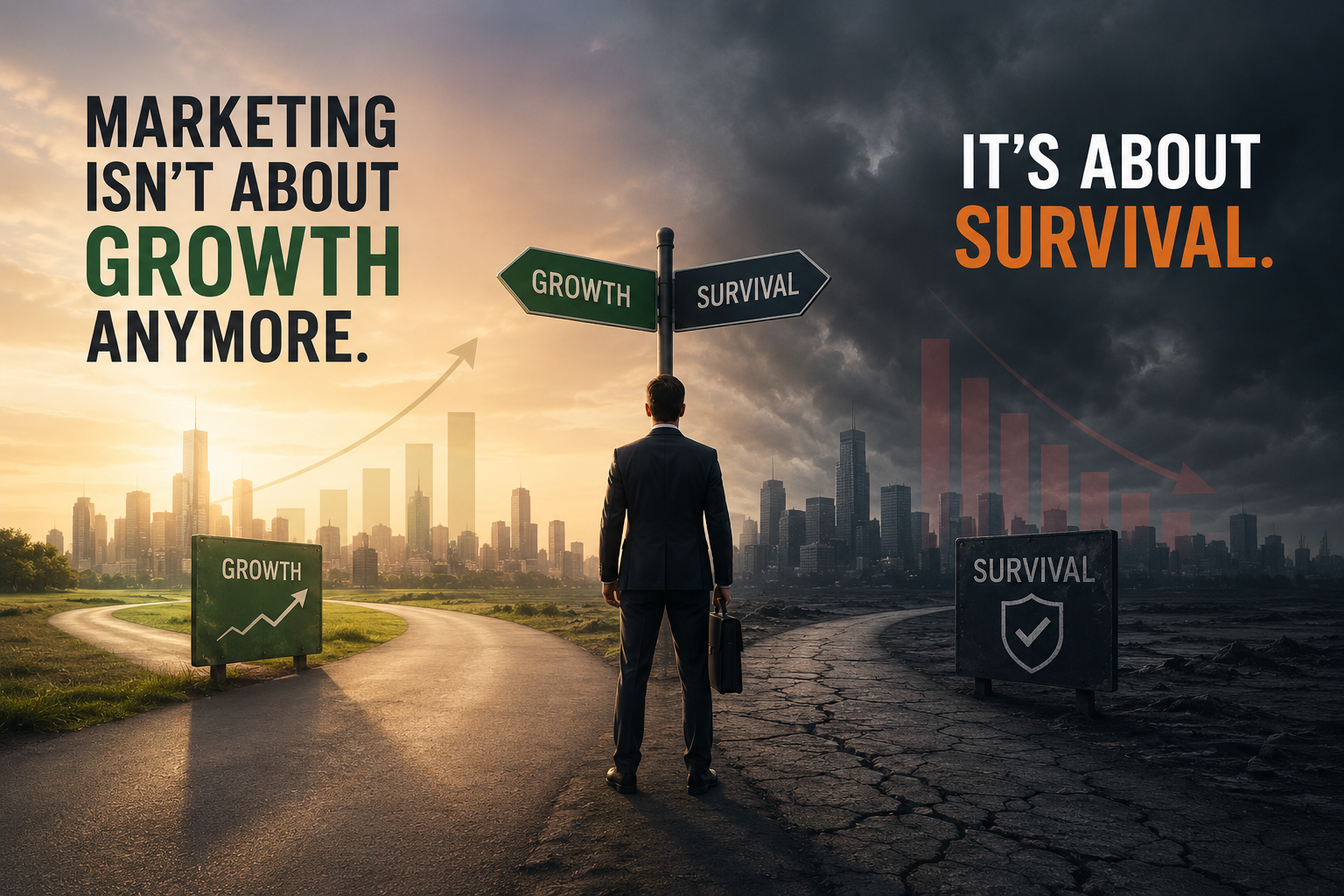
Today, many businesses are no longer competing primarily for growth.
They are competing for survival.
Not survival in the dramatic sense.
Strategic survival.
The ability to remain relevant, profitable, and visible in an increasingly saturated market.
Because modern marketing is no longer operating in an environment of easy expansion.
It is operating in an environment of pressure.
The Reality of Market Saturation
Almost every industry is crowded now.
More brands.
More products.
More creators.
More ads.
More content.
Barriers to entry have collapsed.
Launching a brand is easier than ever.
Building visibility is harder than ever.
This creates saturation.
And saturation changes the rules of competition.
In unsaturated markets, visibility itself can create demand.
In saturated markets, visibility is not enough.
Because customers already have options.
Too many options.
This means brands are no longer fighting to introduce themselves to the market.
They are fighting to justify why they deserve attention over countless alternatives.
And as categories mature, differentiation becomes harder.
Products become similar.
Messaging becomes repetitive.
Visual identity starts to converge.
Everything begins to feel interchangeable.
This is one of the defining problems of modern marketing:
Not lack of exposure.
Lack of distinction.

Rising Ad Costs and Shrinking Margins
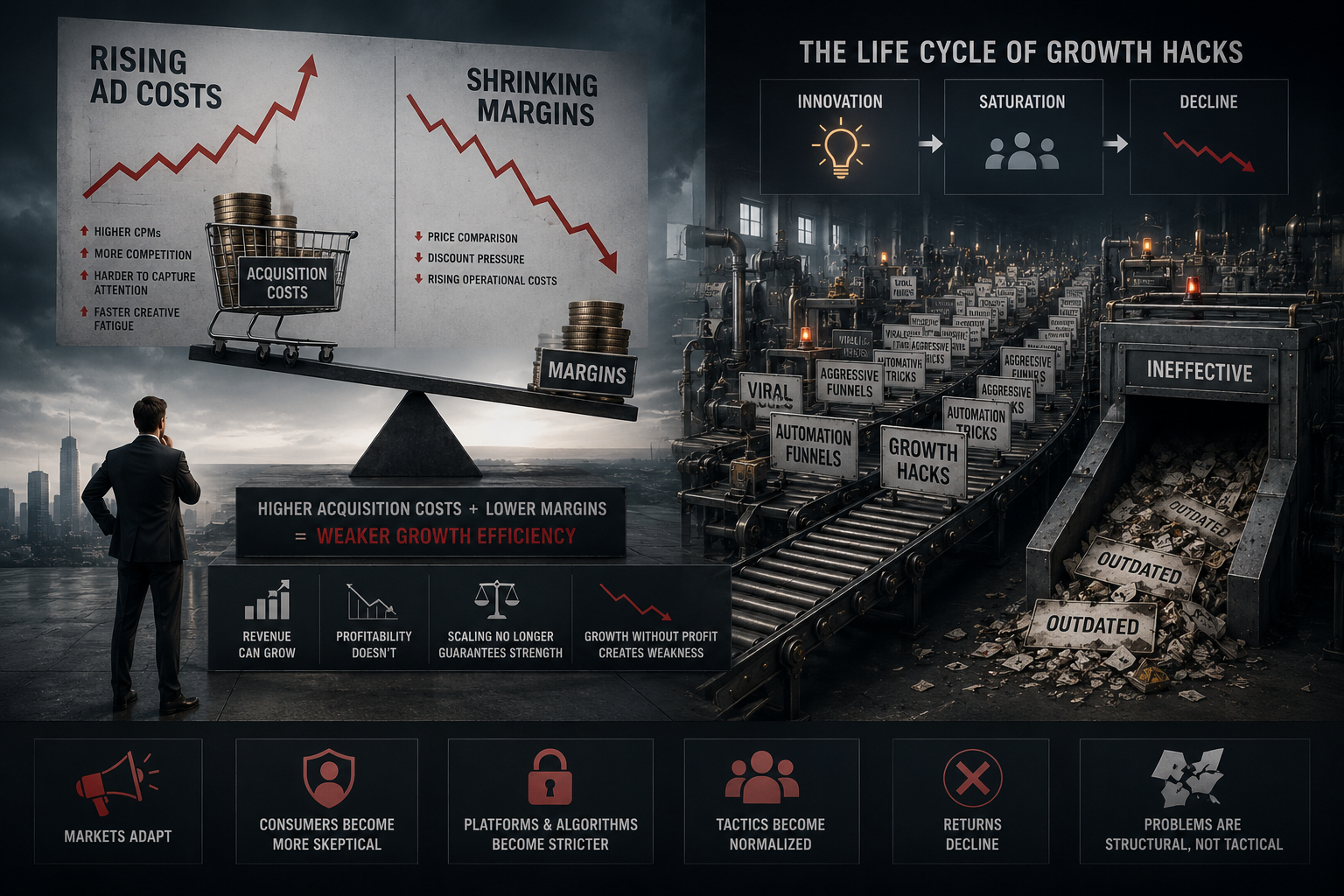
At the same time, customer acquisition has become more expensive.
Advertising platforms are more competitive.
CPMs are higher.
Attention is harder to capture.
Creative fatigue happens faster.
This increases acquisition costs across industries.
But rising costs are only part of the problem.
Margins are shrinking too.
Consumers compare prices more easily.
Competition increases discount pressure.
Operational costs rise.
This creates a dangerous equation:
Higher acquisition costs + lower margins = weaker growth efficiency
Many brands can still generate revenue.
But they struggle to generate profitable growth.
Which means scaling no longer guarantees strength.
A business can grow and still become financially weaker.
That changes how marketing must be approached.
Because in this environment, efficiency matters more than volume.
Why “Growth Hacks” Stopped Working
For years, marketing culture became obsessed with shortcuts.
Growth hacks.
Viral loops.
Aggressive funnels.
Automation tricks.
The idea was that rapid growth could be engineered through tactics alone.
And in earlier digital environments, some of these tactics worked temporarily.
But markets adapted.
Platforms evolved.
Consumers became more skeptical.
Algorithms became stricter.
Tactics that once created advantage became normalized.
Then they became ineffective.
This is the lifecycle of most growth hacks:
Innovation → Saturation → Decline
What worked when few people used it stops working when everyone copies it.
As a result, many brands today are applying outdated tactics in oversaturated environments.
And the returns continue to decline.
Because modern marketing problems are no longer primarily tactical.
They are structural.
Brands Are Fighting for Relevance, Not Expansion
One of the biggest shifts in modern marketing is this:
The real battle is no longer scale.
It is relevance.
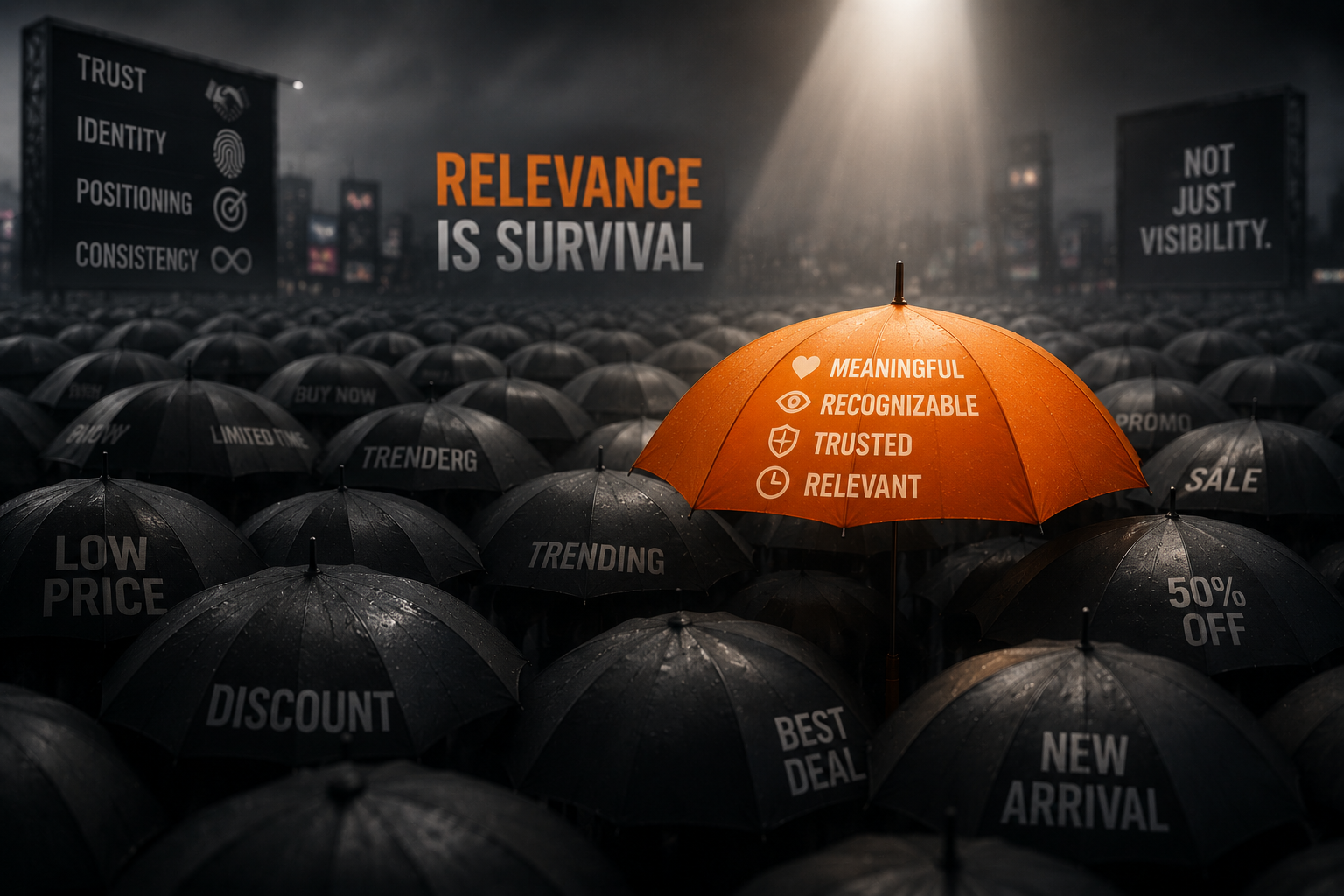
Can the brand remain meaningful?
Can it remain recognizable?
Can it remain trusted?
Can it stay culturally and commercially relevant over time?
This is a different challenge.
It requires more than visibility.
It requires positioning.
Identity.
Trust.
Consistency.
Brands that lose relevance become fragile.
Even if they still generate traffic.
Because traffic without emotional connection is unstable.
The audience leaves as soon as a cheaper, newer, or more entertaining alternative appears.
This is why relevance has become a survival mechanism.
Not just a branding concept.
Survival Through Differentiation
In saturated environments, survival depends on distinction.
Not louder marketing.
Clearer positioning.
Brands that survive long-term are usually the ones that become identifiable quickly.
They stand for something specific.
They communicate consistently.
They create recognizable patterns.
This reduces substitution risk.
Because customers stop seeing them as interchangeable.
Differentiation also protects margins.
If the market perceives no difference between brands, competition shifts toward price.
And price competition destroys profitability over time.
Strong differentiation changes the conversation.
The customer no longer asks:
Which option is cheapest?
They ask:
Which option feels right for me?
That shift is strategically powerful.
Because it moves competition away from pure transaction and toward perception.
The Climax: Adapt or Disappear
This is the core reality of modern marketing.
The environment changed faster than most brands adapted.
Many businesses are still using expansion-era strategies inside survival-era markets.
They optimize for scale while losing relevance.
They increase ad spend while differentiation weakens.
They chase reach while identity becomes diluted.
And eventually, performance stalls.
Not because the market disappeared.
But because the strategy stopped matching the environment.
This is why adaptation is no longer optional.
Brands that fail to evolve become invisible.
And invisible brands disappear slowly.
First from attention.
Then from memory.
Then from the market.
CTA: Rethink Strategy Before Scaling
When growth slows, the instinct is usually to push harder.
More ads.
More campaigns.
More content.
More spend.
But scaling a weak strategy only accelerates inefficiency.
Before asking:
How do we grow faster?
Brands should ask:
Are we structurally strong enough to scale at all?
Step 1: Diagnose Relevance Before Reach
A brand that is not relevant cannot scale sustainably.
So first evaluate:
• Do customers understand what makes us different?
• Are we memorable or interchangeable?
• Are we building recognition or just visibility?
If the answers are weak, the issue is not scale.
It is positioning.
Step 2: Focus on Efficiency, Not Just Expansion
Growth without profitability is fragile.
This means brands must optimize for:
Retention
Trust
Customer lifetime value
Brand recall
Organic demand
Not just acquisition volume.
Efficient growth survives pressure.
Inefficient growth collapses under it.
Step 3: Build Strategic Differentiation
Differentiation is no longer optional.
It is defensive infrastructure.
Without it, the market pushes brands into commodity competition.
And commodities survive only through lower prices.
Strong positioning protects against this.
Step 4: Adapt Continuously
Markets evolve constantly.
Consumer behavior shifts.
Platforms change.
Attention patterns move.
Brands that survive are not necessarily the biggest.
They are the most adaptive.
Adaptation is now part of strategy itself.
Final Perspective
Modern marketing is no longer a guaranteed path to expansion.
It is a system of competitive survival.
And survival belongs to brands that can remain:
Relevant
Recognizable
Trusted
Different
So before scaling faster, ask a more important question:
Would our brand still matter if the market became twice as competitive tomorrow?
Because in saturated markets, growth is not the starting point.
Survival is.
And only strong brands survive long enough to grow.