For years, virality became the goal.
Get more views.
Get more shares.
Get more reach.
Go viral.
The assumption was simple:
If you go viral, you grow.
And sometimes, that is true.
A viral moment can bring massive attention.
It can create spikes in traffic.
It can generate short-term sales.
But most of the time, something else happens.
The spike disappears.
And so does the impact.
Because virality is not the same as growth.
And attention is not the same as brand.
Short-Term Wins vs Long-Term Equity
Virality creates peaks.
Brand building creates stability.
A viral post can generate thousands of views in hours.
A viral campaign can drive sudden interest.
But what happens after?
In many cases, nothing.
The audience moves on.
The content is forgotten.
The brand is not remembered.
Because short-term attention does not automatically translate into long-term equity.
Brand equity is built differently.
It is built through:
Consistency
Repetition
Clarity
Recognition
It accumulates over time.
Virality is a moment.
Brand equity is a system.
And systems outperform moments in the long run.
Why Virality Is Unpredictable
One of the biggest problems with virality is control.
You cannot reliably engineer it.
Content goes viral for many reasons:
Timing
Cultural context
Platform dynamics
Audience mood
Random amplification
Even highly experienced teams cannot guarantee it.
A piece of content that seems average can explode.
A carefully crafted campaign can fail.
This unpredictability makes virality a weak foundation for strategy.
Because you cannot build a system around something you cannot reproduce.
Chasing virality often leads to inconsistency.
Brands experiment with random formats.
They jump on trends without alignment.
They change tone frequently.
This creates noise.
Not identity.

Identity Creates Consistency
Identity solves a different problem.
It answers:
Who are we?
What do we stand for?
How do we show up consistently?
When identity is clear, content becomes coherent.
Even if formats change, the underlying message remains stable.
The audience begins to recognize patterns:
Tone
Perspective
Visual style
Ideas
Values
Recognition reduces friction.
The audience does not need to re-evaluate the brand every time.
They already understand it.
This makes communication more efficient.
Because each new piece of content builds on what already exists.
Identity creates continuity.
And continuity is what allows brands to grow beyond single moments.
Audience Loyalty vs Viral Spikes
Virality attracts attention.
Identity builds loyalty.
A viral spike brings a large audience quickly.
But that audience is often shallow.
They came for the content.
Not for the brand.
Once the content disappears, so do they.
Loyalty works differently.
It develops slowly.
Through repeated interactions.
Through consistent value.
Through aligned messaging.
Loyal audiences:
Return regularly
Engage deeply
Recommend the brand
Trust the brand
This creates a more stable growth model.
Instead of relying on spikes, the brand grows through accumulation.
Over time, loyalty becomes more valuable than reach.
Because loyal audiences convert more, stay longer, and reduce acquisition costs.

Examples of Forgotten Viral Brands
The digital landscape is full of viral moments that led nowhere.
Brands that had one trending product.
One viral video.
One widely shared campaign.
They gained attention.
But they did not build identity.
So they were forgotten.
Why?
Because nothing connected the moment to a larger meaning.
The audience remembered the content.
Not the brand.
This is a critical distinction.
If people remember what you did, but not who you are, growth does not compound.
Recognition stays at the content level.
Not the brand level.
And content without identity has a short lifespan.
The Climax: Attention Without Identity Fades
This is the central reality.
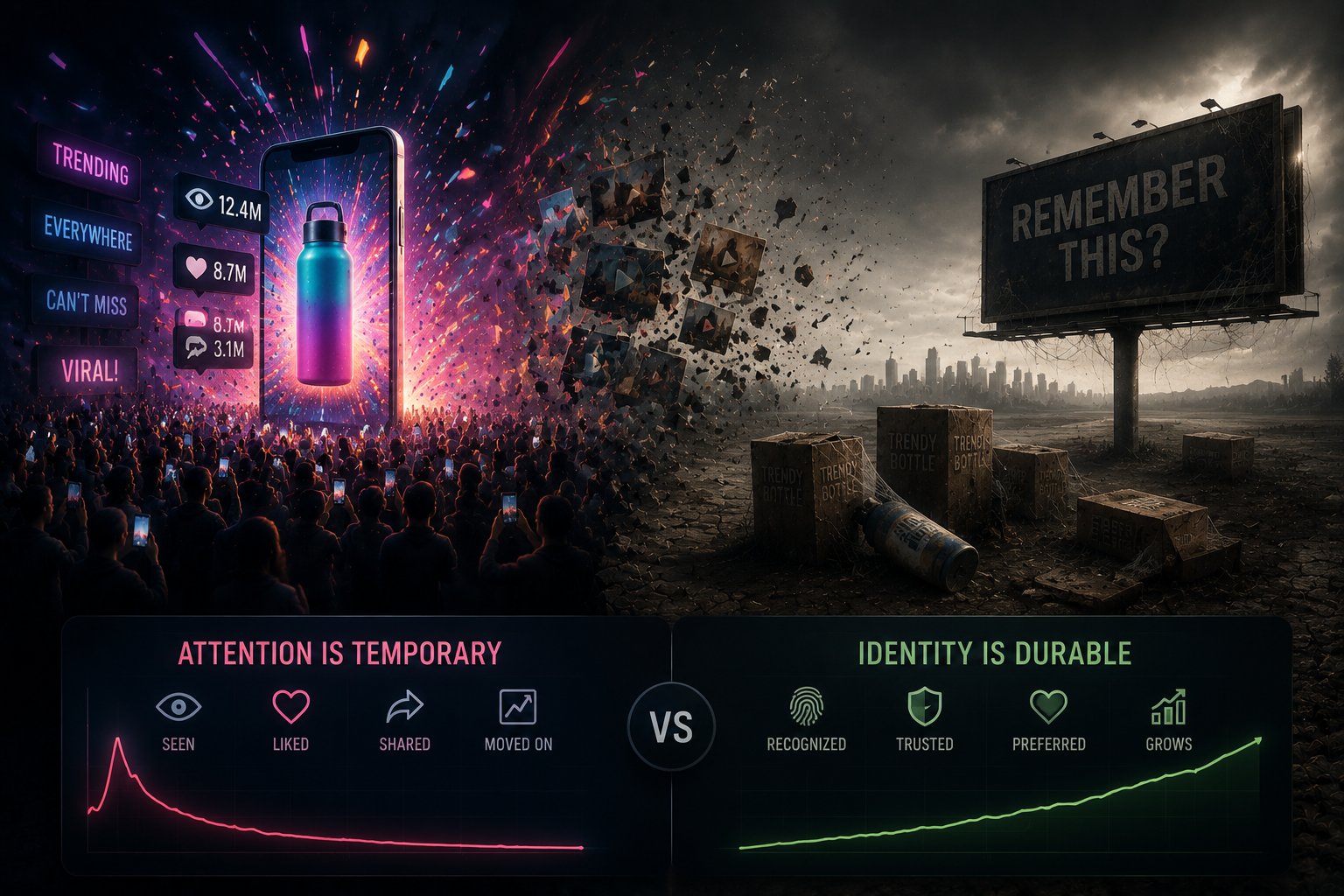
Attention is temporary.
Identity is durable.
A viral moment can put you in front of millions.
But if those millions cannot understand what you represent, the attention dissolves.
It does not convert into memory.
It does not convert into trust.
It does not convert into preference.
This is why many brands feel stuck.
They achieve visibility.
But they do not achieve recognition.
Because recognition requires consistency.
And consistency comes from identity.
Without identity, attention resets.
Every time.
CTA: Build Something Recognizable
If virality is unpredictable and short-lived, then the real strategic objective must change.
Not:
How do we get more views?
But:
How do we become instantly recognizable over time?
Because recognition is what converts exposure into memory.
And memory is what converts attention into brand.
Without recognition, every piece of content starts from zero.
With recognition, every piece of content builds on what already exists.
Step 1: Define a Clear Identity System (Not Just a Brand Statement)
Most brands have a positioning statement.
Very few have an identity system.
A statement is something you write.
A system is something you repeat.
Identity must be visible in patterns:
- Tone of voice
- Type of ideas you share
- Visual consistency
- Point of view on your industry
- What you consistently emphasize, and what you ignore
If these elements change frequently, the audience cannot form a stable perception.
And without stable perception, recognition never forms.
Step 2: Optimize for Memory, Not Just Performance
Most teams optimize for short-term metrics:
Views
Likes
Shares
Engagement rate
These matter.
But they do not guarantee memorability.
Recognition comes from repeated exposure to consistent signals.
So the real question is not:
Did this perform well?
But:
Did this reinforce what we want to be known for?
High-performing content that does not align with identity creates confusion.
Moderate-performing content that reinforces identity builds long-term strength.
This is a strategic trade-off.
And most brands get it wrong.
Step 3: Use Repetition as a Tool, Not a Weakness
Many brands avoid repetition because they fear being boring.
But audiences do not experience your brand continuously.
They experience it intermittently.
What feels repetitive internally often feels consistent externally.
Repetition is how the brain encodes memory.
Same ideas.
Same angles.
Same perspective.
Expressed in different formats.
This is how identity compounds.
Without repetition, recognition resets.
Step 4: Filter Opportunities Through Identity
Virality often tempts brands to chase trends.
But not every opportunity strengthens your brand.
Before participating in any trend or format, ask:
- Does this align with our identity?
- Does it reinforce what we want to be known for?
- Or does it distract from it?
Growth opportunities that dilute identity create long-term weakness.
Growth opportunities that reinforce identity create long-term equity.
This requires restraint.
And restraint is a strategic advantage.
Step 5: Build for Accumulation, Not Spikes
Virality is episodic.
Identity is cumulative.
Brands that chase spikes experience unstable growth:
High attention → Drop → Repeat
Brands that build identity experience accumulation:
Consistent exposure → Recognition → Trust → Preference
This model is slower at the beginning.
But stronger over time.
Because each interaction adds to something.
Instead of disappearing.
Final Perspective
Most brands are not invisible because they lack exposure.
They are invisible because they lack consistency in how they show up.
They change too often.
Experiment too randomly.
Adapt without direction.
As a result, the audience never forms a clear mental model.
And without that model, recognition cannot exist.
In a crowded market, being seen is not enough.
Being remembered is what matters.
And memory is built through identity.
So before chasing your next viral moment, ask:
If someone saw five pieces of our content, would they recognize us instantly?
If the answer is no, the problem is not reach.
It is identity.
Fix that first.
Then let attention follow.