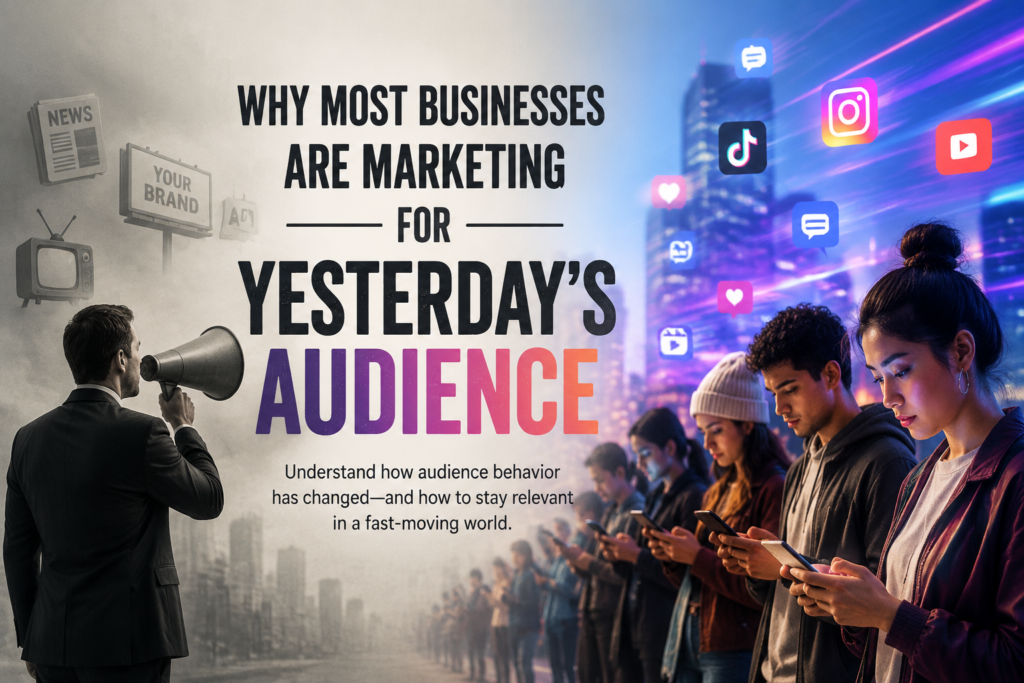
For years, marketing followed a predictable logic.
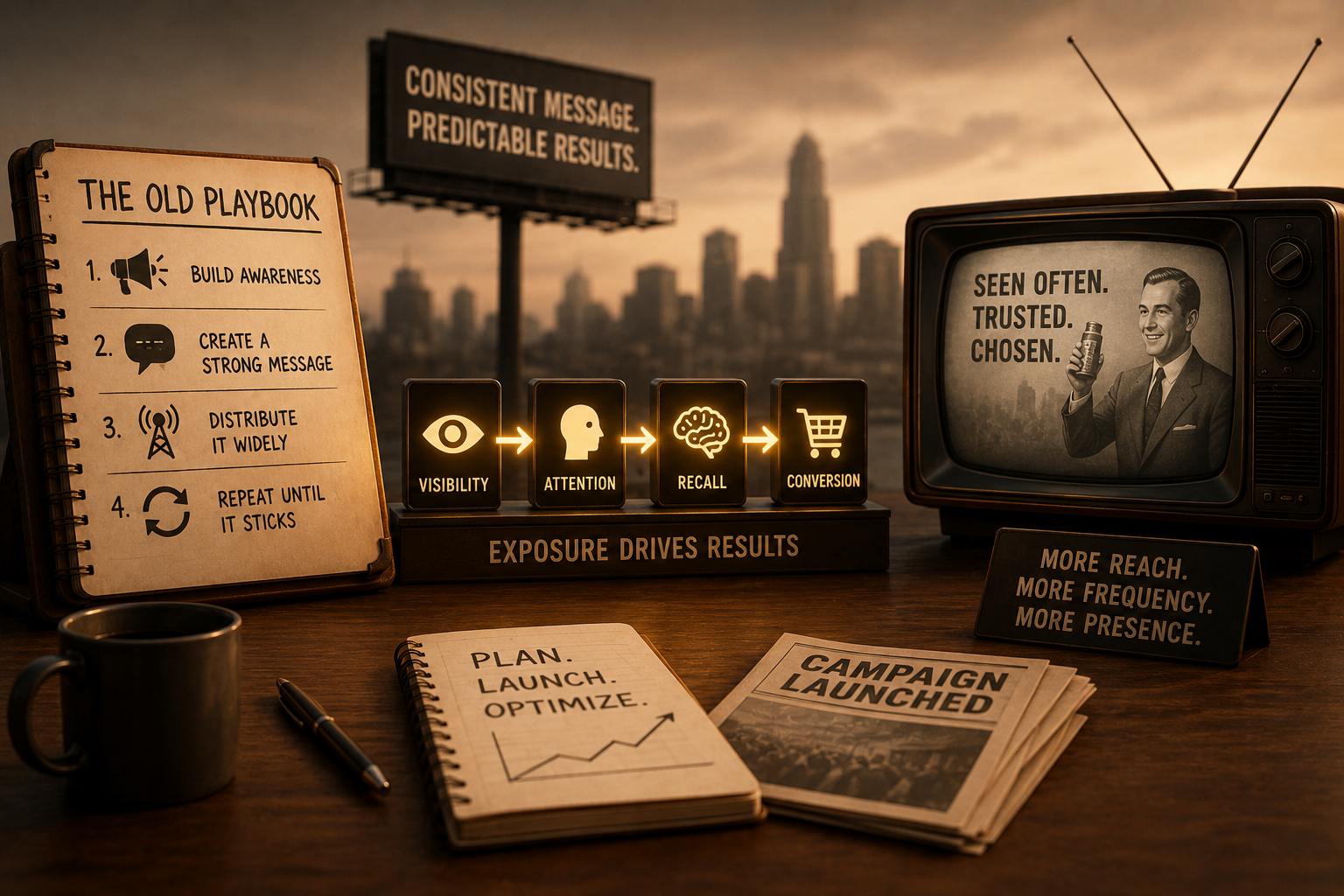
Build awareness.
Create a strong message.
Distribute it widely.
Repeat until it sticks.
This was the old playbook.
And for a long time, it worked.
Because the environment supported it. Attention was easier to capture, distribution was easier to control, and audiences had fewer competing inputs. Marketing was not chaotic. It was structured.
If you understood the system once, you could reuse it repeatedly with consistent outcomes.
But that system has fundamentally changed.
The problem is not that brands are failing to execute.
The problem is that many are still executing a model that no longer reflects reality.
What the Old Playbook Actually Was
The old playbook was built on a single core assumption:
Exposure drives results.
If enough people saw your message often enough, performance would follow.
This created a linear model:
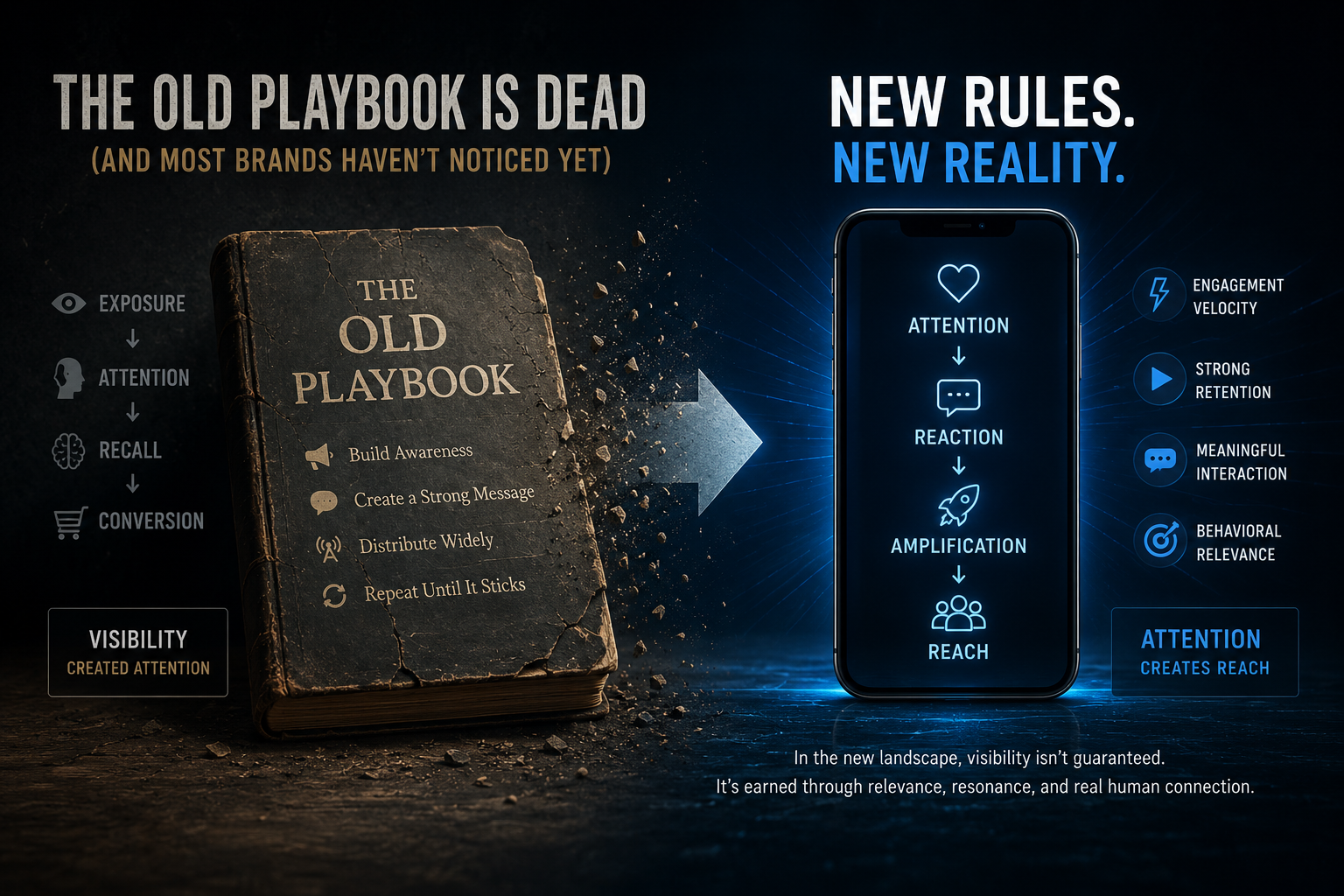
Visibility → Attention → Recall → Conversion
It relied on repetition.
It rewarded consistency.
And it scaled with budget.
Marketing, in this context, was primarily a distribution problem.
The brand that could buy more reach, more frequency, and more presence had an advantage. Creative quality mattered, but it operated within a system that was forgiving. Even average campaigns could perform if they were visible enough.
This is why planning cycles were stable.
Campaigns were designed, launched, and optimized gradually. There was time for messaging to land, for awareness to build, and for familiarity to translate into trust.
The system allowed for delay.
And that delay was part of why it worked.
Why It Worked Before
The effectiveness of the old playbook was not just about strategy. It was about context.
Content was limited.
Attention was less fragmented.
Competition was lower.
Brands were not competing with thousands of daily content inputs. They were competing within relatively controlled media environments.
Distribution was also more direct.
If you paid for exposure, you received it.
Platforms did not aggressively filter content based on early performance signals. Visibility was more predictable, and less conditional.
Audiences were different as well.
They were less saturated.
Less skeptical.
Less trained to ignore messaging.
Repetition worked because it faced less resistance.
A message seen multiple times had a high probability of entering memory. Memory influenced preference. Preference influenced behavior.
In short, the system was aligned.
The structure of media, the behavior of audiences, and the strategies of brands were operating within the same logic.
That alignment no longer exists.
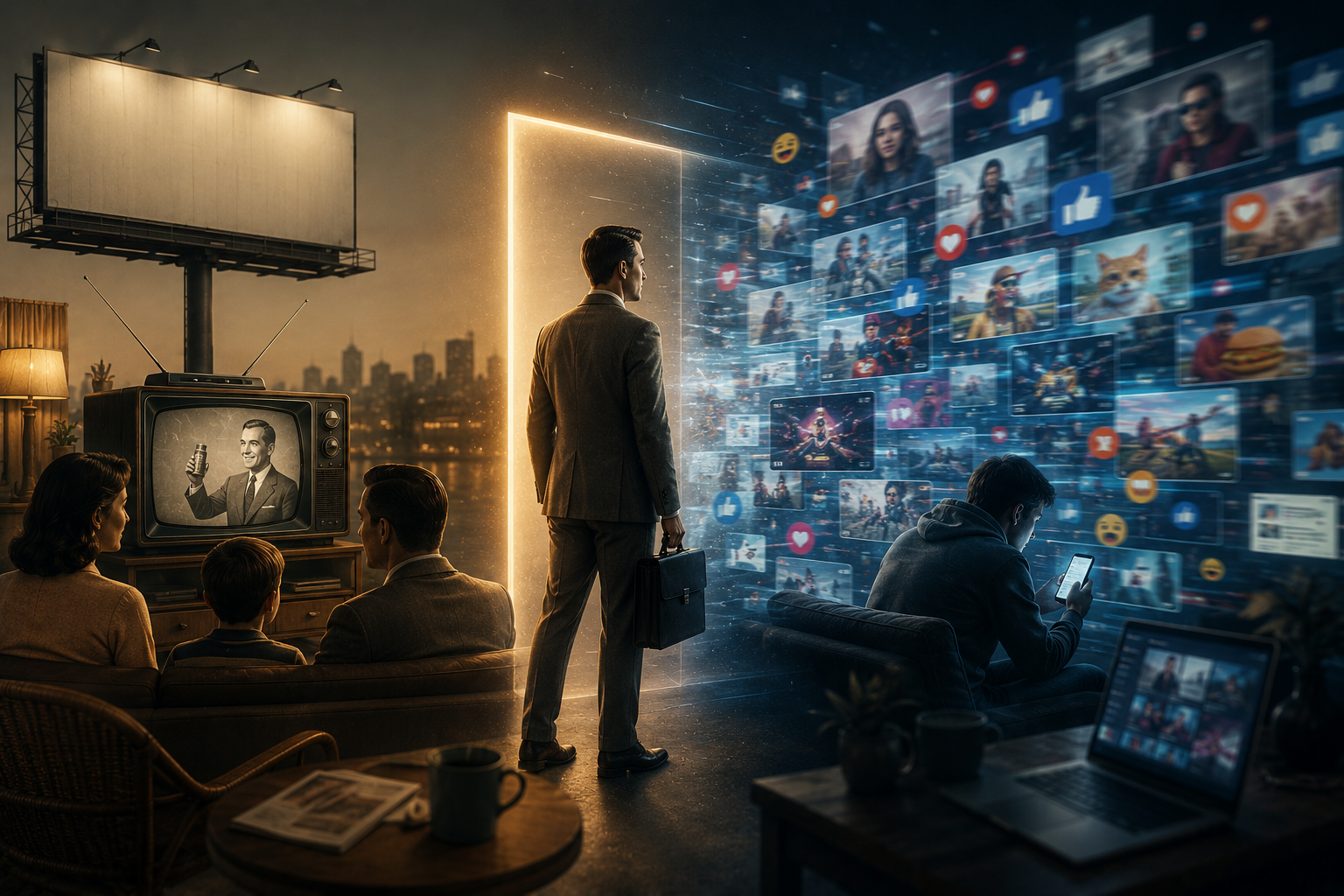
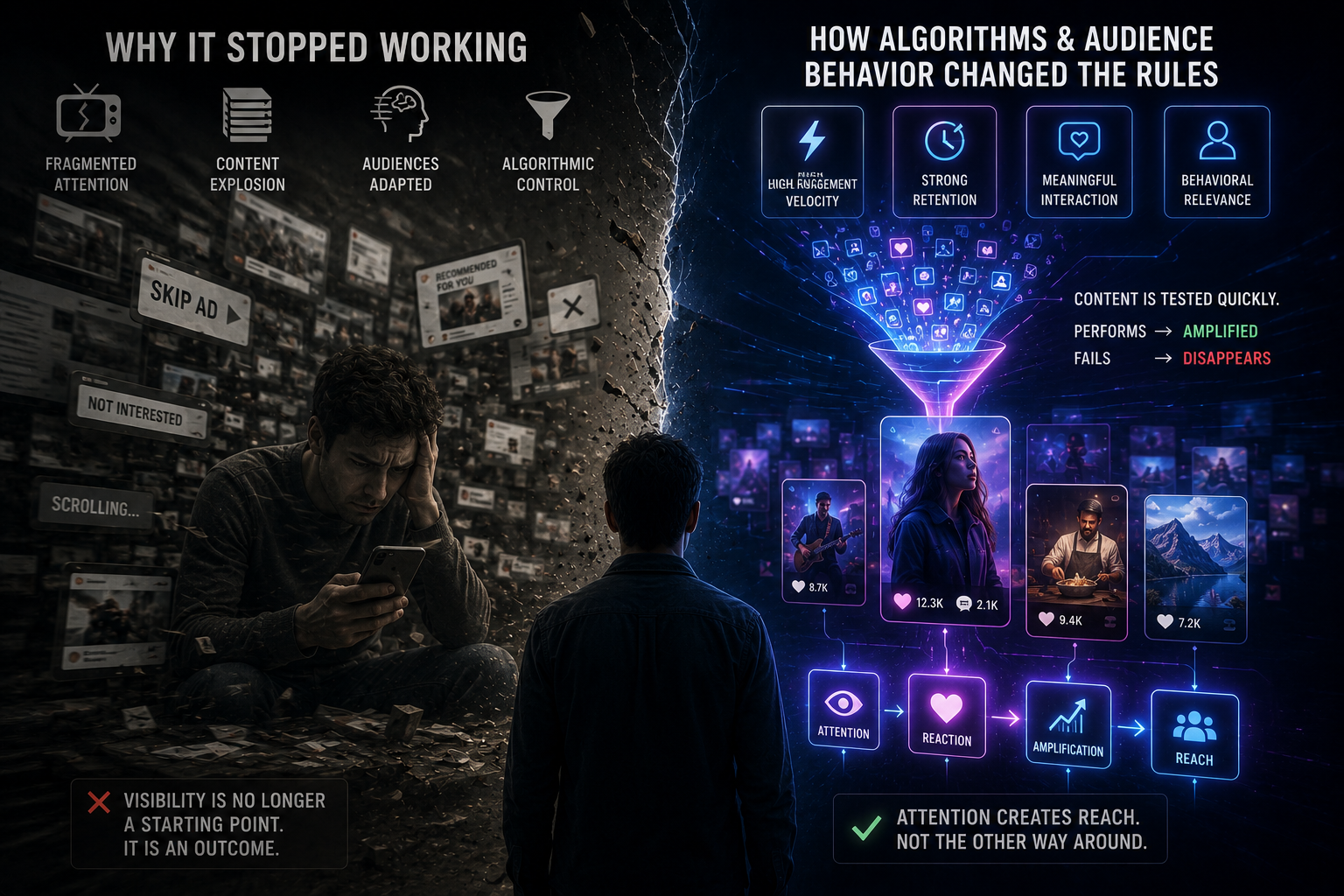
Why It Stopped Working
The breakdown happened at a structural level.
First, attention became fragmented.
Consumers now navigate multiple platforms, formats, and contexts continuously. Their attention is divided across entertainment, communication, work, and information, often within the same hour.
This reduces the effectiveness of repeated exposure.
Second, content volume exploded.
Every brand publishes.
Every creator publishes.
Every user contributes to the content ecosystem.
This creates abundance.
And in an environment of abundance, visibility loses value unless it is earned.
Third, audiences adapted.
They became faster in processing and quicker in dismissing content. They recognize patterns, detect inauthenticity, and ignore anything that feels predictable or forced.
They do not evaluate content slowly.
They filter instantly.
Finally, platforms introduced algorithmic control.
Content is no longer distributed equally.
It is ranked, filtered, and amplified based on behavioral signals.
If content does not generate immediate response, it is suppressed.
This changes everything.
Visibility is no longer a starting point.
It is an outcome.
How Algorithms and Audience Behavior Changed the Rules
Modern platforms operate on selective amplification.
They prioritize content that demonstrates:
- High engagement velocity
- Strong retention
- Meaningful interaction
- Behavioral relevance
This creates a feedback system.
Content is tested quickly.
If it performs, it is expanded.
If it fails, it disappears.
This means distribution is no longer guaranteed.
It is conditional.
At the same time, audiences have adapted to this environment.
They scroll faster.
Decide faster.
Ignore faster.
They do not passively receive content.
They actively filter it.
Within seconds, they determine whether something is worth attention.
If it is not, they move on.
And when they move on, the algorithm reads that signal.
This creates a new model:
Attention → Reaction → Amplification → Reach
If reaction does not happen, reach does not scale.
This is a reversal of the old system.
Before, reach created attention.
Now, attention creates reach.
That inversion is the core shift in modern marketing.
Brands Are Still Copying Outdated Strategies
Despite this shift, many brands continue to operate using outdated logic.
They prioritize output over response.
They focus on consistency over relevance.
They invest in production over positioning.
They assume that more content leads to more visibility.
But in algorithmic systems, weak content does not accumulate.
It gets filtered out.
In fact, low-performing content can reduce future reach by signaling low relevance to the platform.
This creates a negative loop:
Low response → Reduced distribution → Lower response
Instead of addressing the root problem, brands often increase volume.
More posts.
More campaigns.
More spend.
But the issue is not quantity.
It is alignment.
Another common mistake is overvaluing polish.
High production quality does not guarantee performance.
Content succeeds when it matches audience context, emotional state, and platform behavior.
Not when it simply looks good.
A simple, well-timed, relevant idea can outperform a highly produced campaign.
Because response drives distribution.
Not effort.
The Climax: Playing a Game That No Longer Exists
This is the central issue.
Brands are not just underperforming.
They are operating within an outdated system.
They are trying to scale exposure in a system that rewards reaction.
They are optimizing for impressions when the real metric is engagement quality.
They are following frameworks designed for a different media environment.
And no matter how well they execute, the results are limited.
Because the underlying assumptions are no longer valid.
The old model assumed:
If people see it, they will care.
The new reality is:
If people don’t care immediately, they will never see it.
This is not a tactical adjustment.
It is a structural shift.
And it requires a different way of thinking.

What This Means Strategically
Marketing is no longer just about delivering messages.
It is about navigating systems.
Brands need to understand:
- How platforms rank and distribute content
- How audiences interpret signals quickly
- How context influences perception
- How timing affects performance
This requires a shift from static planning to adaptive strategy.
From output-based thinking to response-based thinking.
From control to alignment.
Content must be designed for reaction.
Not just for communication.
Not all content serves the same purpose.
Some content creates reach.
Some builds trust.
Some drives conversion.
Treating all content equally leads to inefficiency.
Instead, brands need clarity on function.
They also need to respect platform differences.
A message that works in one environment may fail in another.
Because each platform has its own behavioral logic.
Finally, brands must be selective.
Not every trend is an opportunity.
Not every conversation is relevant.
Strategic restraint is now as important as activity.
CTA: Stop Copying, Start Rethinking
If your marketing is underperforming, the issue may not be execution.
It may be your model.
Stop copying what used to work.
Start questioning what works now.
Ask:
- Is this designed for how content is actually distributed today?
- Does it trigger immediate audience response?
- Are we earning attention or trying to force it?
Because visibility is no longer guaranteed.
It is conditional.
And performance is not driven by how much you produce.
It is driven by how your content behaves.
The brands that succeed are not the ones who produce the most.
They are the ones who adapt the fastest.
The old playbook is not evolving.
It is obsolete.
And the sooner you stop relying on it, the sooner you can start building a strategy that actually works today.