For decades, marketing was treated as a creativity-driven game. The boldest campaign, the most emotional storytelling, the most visually striking execution, these were considered the winning ingredients. Creative brilliance was seen as the ultimate differentiator.
That era has shifted.
Today, marketing is no longer primarily a creativity competition. It is a timing discipline.
In a hyper-saturated digital ecosystem where attention is fragmented, algorithms decide visibility, and consumers process information within seconds, timing has become a structural advantage, not a secondary consideration.
Creativity still matters.
But creativity without timing is inefficient.
And in some cases, it is destructive.
Why Average Ideas Win When Timed Correctly
One of the most misunderstood realities in modern marketing is this:
An average idea executed at the right moment will outperform a brilliant idea executed at the wrong one.
This happens because marketing does not exist in isolation. It operates inside a living system that includes:
- Market demand cycles
- Consumer purchasing power
- Cultural climate
- Emotional context
- Platform algorithms
- Competitive positioning
When timing aligns with demand, performance increases naturally.
When timing misaligns, even the strongest creative execution struggles.
Consumers are not just evaluating the quality of your idea.
They are evaluating whether it is relevant now.
Relevance is time-sensitive. Creativity is not.
The New Strategic Formula: Market Readiness × Timing
The traditional belief was:
Creativity × Budget = Impact
The more realistic formula today is:
Market Readiness × Strategic Timing × Consistency = Sustainable Performance
Market readiness includes multiple variables:
- Is there active demand for this product or message?
- Is the audience emotionally receptive?
- Is the economic environment supportive?
- Is the topic socially sensitive?
- Is your brand positioned correctly to speak?
If market readiness is low, creative effort does not convert.
Timing determines whether the market can absorb your message.

Timing Extends Beyond Posting Schedules
Many marketers reduce timing to surface-level tactics:
“post at peak engagement hours.”
That is tactical timing.
Strategic timing is much broader.
It includes structural factors such as:
1. Supply and Demand Alignment
No campaign can outperform weak demand conditions.
If supply exceeds demand significantly, aggressive marketing may increase awareness, but it won’t generate proportional revenue.
Conversely, if demand exists but supply is constrained, poorly timed campaigns can create operational stress.
Timing impacts:
- Product launches
- Inventory cycles
- Seasonal demand
- Economic fluctuations
- Pricing strategy
For example:
Launching a premium product during economic contraction reduces probability of conversion, regardless of campaign creativity.
Supply-demand synchronization is a timing issue before it is a creative issue.
2. Local Market Intelligence
If a brand operates in a local market, timing becomes even more sensitive.
Global trends may not reflect local sentiment.
A campaign that performs well internationally can fail regionally if it ignores:
- Local economic pressure
- Cultural events
- Social tensions
- Regional consumer behavior
- Community priorities
Local timing requires continuous awareness.
Brands that ignore local context risk irrelevance, or backlash.
3. Real-Time Market Monitoring
Modern marketing requires ongoing monitoring, not static planning.
Strategic timing depends on constant updates regarding:
- Industry developments
- Platform algorithm changes
- Consumer sentiment shifts
- Competitor campaigns
- Regulatory changes
Timing is dynamic. It is not decided once per quarter.
The brands that win are those that monitor continuously and adjust deliberately.

Consumers Have Become Strategically Aware
One of the most critical shifts in modern marketing is audience intelligence.
Consumers are no longer passive recipients of advertising.
They can detect:
- Inauthentic positioning
- Opportunistic messaging
- Sudden identity shifts
- Emotional manipulation
- Tone inconsistency
They don’t just analyze what you say.
They analyze why you’re saying it.
If a message does not align with brand identity, timing alone cannot save it.
Authenticity is now part of timing.
A message delivered at the “right time” but outside brand identity feels forced, and modern audiences recognize that instantly.
A Successful Timing Case: Oreo and the Power of Real-Time Marketing
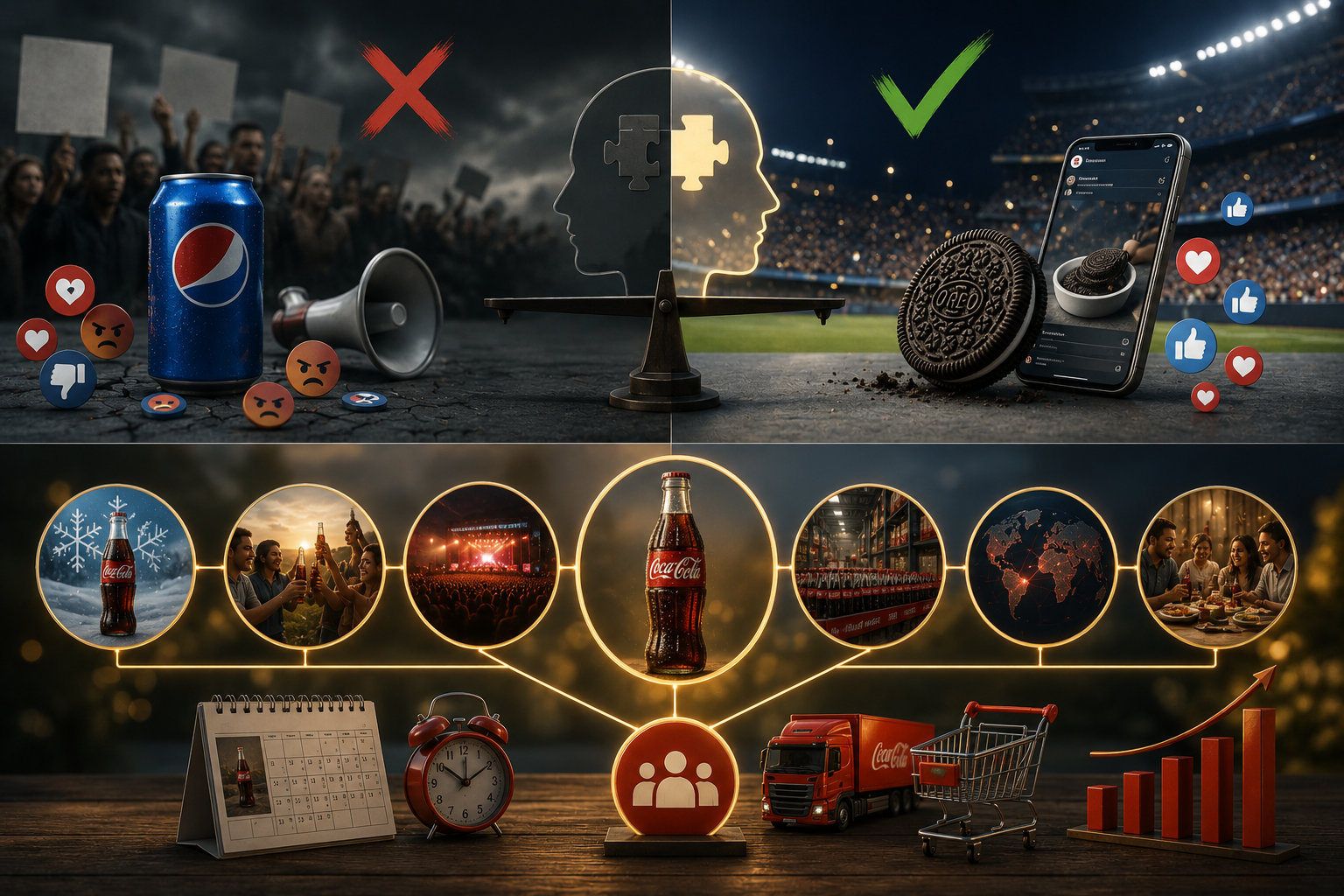
One of the most well-known examples of strategic timing in modern marketing is Oreo’s response during the 2013 Super Bowl blackout.
During the game, the stadium suddenly lost power. Millions of viewers were watching live, and social media exploded with reactions. Within minutes, Oreo’s digital team posted a simple message:
“You can still dunk in the dark.”
There was no massive production.
No expensive video.
No long pre-planned campaign.
Yet the post became one of the most celebrated real-time marketing moments in history.
Why did it work?
Because it wasn’t just fast, it was aligned.
Oreo succeeded because:
- The brand reacted in the exact moment when attention was at its peak.
- The message naturally fit the product and brand identity.
- The tone matched the situation without being insensitive.
- The team had internal readiness to respond quickly and strategically.
The idea itself was simple.
The timing was exceptional.
This case demonstrates a core principle of modern marketing:
When timing, context, and brand identity align, even a small creative idea can generate massive impact.
A Failed Timing Case: Pepsi and Context Misalignment
In contrast, Pepsi’s 2017 campaign featuring Kendall Jenner is often cited as an example of poor timing and context awareness.
The advertisement depicted a protest-like scenario in which Jenner hands a police officer a Pepsi, symbolically resolving tension. From a production standpoint, the campaign was polished and high-budget. Visually, it was professionally executed.
However, the campaign failed.
Not because it lacked creativity.
But because it lacked contextual intelligence.
At the time of the campaign’s release, social tensions and real-world protests were highly sensitive topics. Many audiences interpreted the ad as trivializing serious social issues and using them for commercial gain.
The backlash was immediate and intense. The ad was pulled quickly, and the brand issued a public apology.
Pepsi did not fail due to weak execution.
It failed because the timing and context were misread.
The lesson here is not political, it is strategic.
Timing requires more than speed.
It requires understanding the emotional climate, social sensitivity, and brand positioning before entering a conversation.
The Structural Difference Between Success and Failure
The contrast between Oreo and Pepsi highlights a fundamental difference:
Oreo entered a moment that was culturally light, attention-driven, and naturally compatible with its brand personality.
Pepsi entered a sensitive space where the brand did not have authentic authority or contextual alignment.
Timing is not just about when you speak.
It is about whether your brand belongs in that moment.
Without alignment between brand identity, audience sensitivity, and market readiness, even high-quality creative execution can become a liability.
The Structural Contrast: Coca-Cola
In contrast, brands such as Coca-Cola operate with disciplined timing architecture.
Coca-Cola’s strength is not reactive positioning.
It is structured alignment.
The brand consistently synchronizes:
- Seasonal demand cycles
- Emotional brand identity
- Major events
- Product availability
- Cultural relevance
Rather than inserting itself impulsively into sensitive discussions, it aligns messaging with brand DNA and timing conditions.
Coca-Cola rarely shifts tone dramatically.
It operates within predictable emotional territory, optimism, unity, shared experience.
That consistency allows timing to amplify impact rather than create instability.
The difference is not creativity level.
It is strategic discipline.
Real-Time Marketing: Speed With Control
Real-time marketing is powerful.
But speed without filtering is volatility.
Effective real-time marketing requires:
- Rapid data validation
- Brand-alignment checks
- Context evaluation
- Risk analysis
Brands that react instantly without structural evaluation increase risk exposure.
Brands that combine speed with discipline increase advantage.
Timing is not about moving fast.
It is about moving precisely.
Timing and Algorithmic Visibility
Social media algorithms prioritize:
- Recency
- Engagement velocity
- Topical relevance
- Interaction density
Timing affects reach directly.
A message aligned with trending demand can multiply organic exposure.
A message posted during attention saturation disappears.
Algorithmic amplification is time-sensitive.
Creativity influences engagement.
Timing influences discoverability.
Engagement, Loyalty, and Long-Term Equity
Proper timing strengthens:
- Engagement rate
- Emotional resonance
- Trust perception
- Brand memory
When consumers perceive a brand as context-aware, credibility increases.
When they perceive it as tone-deaf or opportunistic, trust erodes.
Timing impacts not just performance metrics, but brand equity.
Final Conclusion: Timing Is Structural, Not Tactical
Marketing is no longer a creativity contest.
It is a contextual intelligence system.
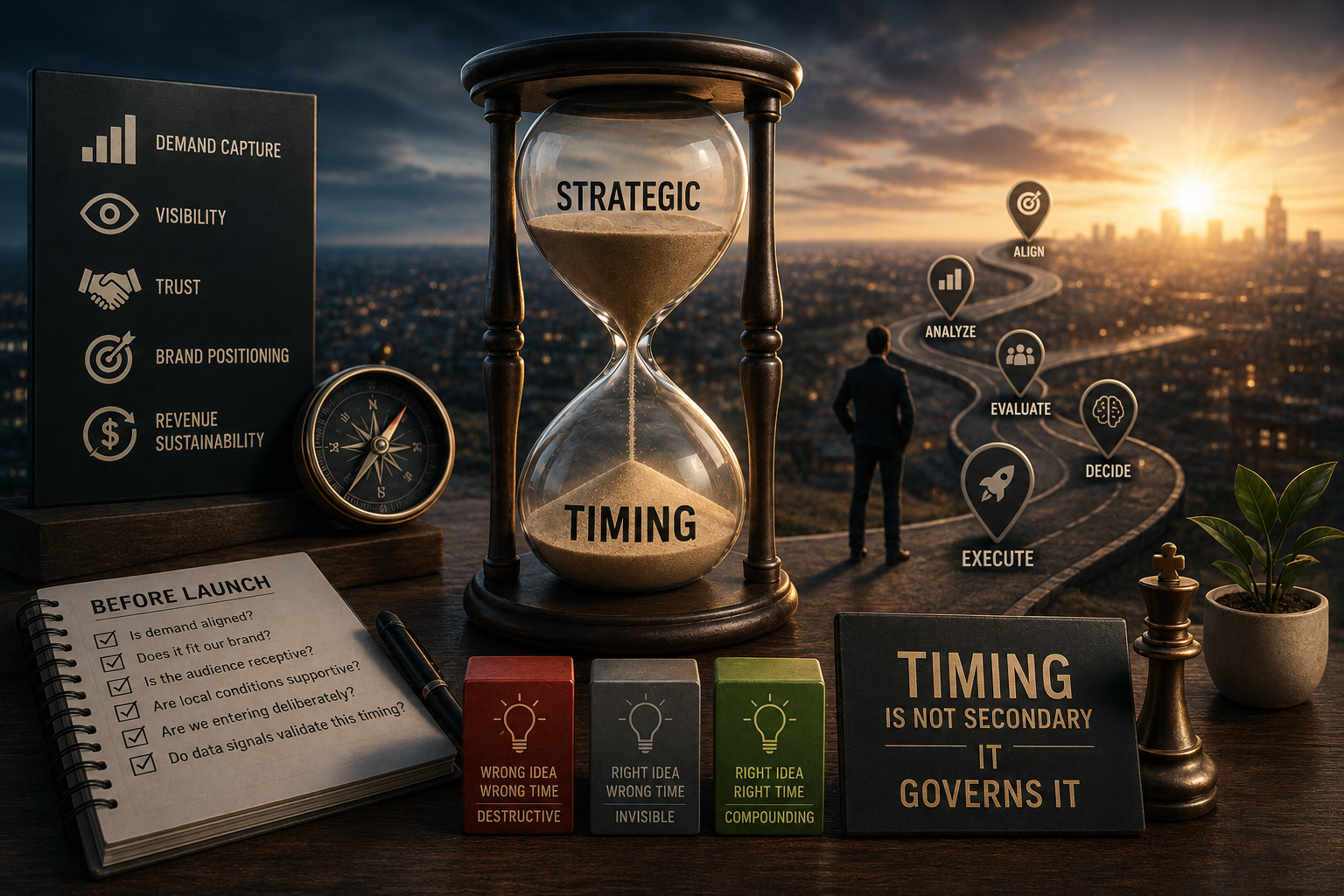
Timing affects:
- Demand capture
- Visibility
- Trust
- Brand positioning
- Revenue sustainability
Brands fail not because they lack ideas, but because they misread the moment.
The brands that consistently outperform are those that:
- Understand supply-demand ratios
- Monitor local and global conditions
- Respect brand identity boundaries
- Stay continuously updated
- Act deliberately rather than reactively
Timing is not a posting tactic.
It is a strategic architecture.
Before Launching Your Next Campaign
Pause.
Evaluate strategically:
- Is demand aligned with this message?
- Does this communication fit our brand identity?
- Is the audience emotionally receptive?
- Are local conditions supportive?
- Are we reacting impulsively, or entering deliberately?
- Do data signals validate this timing?
If clarity is missing, the issue may not be creativity.
It may be timing.
Because in modern marketing:
The right idea at the wrong time is invisible.
The wrong idea at the wrong time is destructive.
But the right idea at the right time is compounding.
Timing is not secondary to creativity.
It governs it.